What are trioxides, Chemistry

Assignment Help:

Q. What are Trioxides?

The selenium and tellurium trioxides are not stable, SO2, is the only important trioxide in the group. Its preparation has been described above.

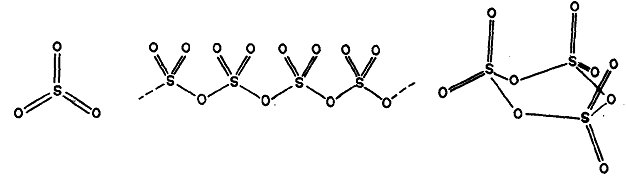
Sulphur trioxide exists in several polymorphic forms. The solid form, m .p. 290 K has a trimetric cyclic structure, in which four oxygen atoms are arranged approximately tetrahedrally around each sulphur atom, Fig. (c). This form gradually changes into a linear polymerised structure in the presence of moisture. The latter has a fibrous needle-like appearance, Fig.(b). On heating, the polymeric form dissociates into discrete SO2, molecules present in the vapour. These have a triangular, symmetrical and planar structure, Fig. (a).
1527_What are Trioxides.png

SO2, is a powerful acidic oxide, it fumes in moist air and reacts explosively with water to form sulphuric acid.

SO3+ H2O------------> H2SO4

With excess SO3 H2S04 gives pyrosulphuric acid or oleum

H2SO4+ SO3-----------------> H2S2O7 (oleum)

In some reactions it acts as an oxidising agent, e.g., it oxidises HBr to free bromine.

2HBr+ SO3------------------> H2O + Br2+ SO2


Related Discussions:- What are trioxides

Illustrate about nuclear particle, Q. Illustrate about nuclear particle? ...

Q. Illustrate about nuclear particle? In 1932 Rutherford with Chadwick demonstrated the existence of the neutron a nuclear particle having no charge but with nearly the same

Standard molar reaction enthalpy and temperature dependence, Q: For a homog...

Q: For a homogeneous reaction in which the reactants and products are solutes in a solution, write a rigorous relation between the standard molar reaction enthalpy and the temperat

Explain the extraction of sulphur, Q. Explain Extraction of Sulphur? Th...

Q. Explain Extraction of Sulphur? The most important method for the extraction of sulphur from native deposits is the frasc process developed by Herman frach in 1891. It consis

Addition reactions - organic chemistry, Addition reactions - Organic Chemis...

Addition reactions - Organic Chemistry Addition reactions are given by those compounds that have at least one p bond, i.e.,

Third law of thermodynamics, what are the limitations of third law of therm...

what are the limitations of third law of thermodynamics. what is thermodynamics third law.

Conductivities, eperiment on conductometric titration on acids and bases

eperiment on conductometric titration on acids and bases

Microwave spectroscopy, Why Microwave performed at low temperature and low ...

Why Microwave performed at low temperature and low pressure

Chemical test, give one chemical test to distinguish the following pairs of...

give one chemical test to distinguish the following pairs of compound ethyl nitrile and nitroetane;benzamide and p-aminobenzonic acid

Write Your Message!

Captcha
Free Assignment Quote

Assured A++ Grade

Get guaranteed satisfaction & time on delivery in every assignment order you paid with us! We ensure premium quality solution document along with free turntin report!

All rights reserved! Copyrights ©2019-2020 ExpertsMind IT Educational Pvt Ltd