Undirected graph and adjacency matrix, Data Structure & Algorithms

Assignment Help:


Q. Consider the specification written below of a graph G

V(G ) = {1,2,3,4}

E(G ) = {(1,2), (1,3), (3,3), (3,4), (4,1)}

(i)        Draw the undirected graph.

(ii)       Also draw its adjacency matrix.                                           


Ans:

V(G) = {1,2,3,4}

E(G) = {(1,2),(1,3),(3,3,),(3,4),(4,1)}

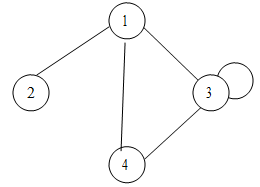
(i). The undirected graph is shown as follows:-


909_Undirected graph.png


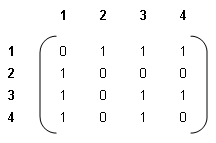
(ii) The adjacency matrix is written as follows:-


942_Adjacency matrix2.png


Related Discussions:- Undirected graph and adjacency matrix

Explain the term - branching, Explain the term - Branching There are t...

Explain the term - Branching There are two common ways of branching: case of ..... otherwise ...... endcase  if ..... then ..... else ..... endif   case of

Algorithm for inorder traversals, Step-1: For the current node, verify whet...

Step-1: For the current node, verify whether it contain a left child. If it has, then go to step-2 or else go to step-3 Step-2: Repeat step-1 for left child Step-3: Visit (th

Ruby implementation of the symbol abstract data type, Ruby implementation o...

Ruby implementation of the Symbol ADT Ruby implementation of the Symbol ADT, as mentioned, hinges on making Symbol class instances immutable that corresponds to the relative la

Algorithm to find maximum and minimum numbers, Give an algorithm to find bo...

Give an algorithm to find both the maximum and minimum of 380 distinct numbers that uses at most 568 comparisons.

Infix expression has balanced parenthesis or not, Q. By making use of stack...

Q. By making use of stacks, write an algorithm to determine whether the infix expression has balanced parenthesis or not.

Arrays, This unit discussed about data structure called Arrays. The easiest...

This unit discussed about data structure called Arrays. The easiest form of array is a one-dimensional array which may be described as a finite ordered set of homogeneous elements

The complexity ladder, The complexity Ladder: T(n) = O(1). It is ca...

The complexity Ladder: T(n) = O(1). It is called constant growth. T(n) does not raise at all as a function of n, it is a constant. For illustration, array access has this c

Algorithms and flowcharts, write an algorithm and draw a flowchart to calcu...

write an algorithm and draw a flowchart to calculate the perimeter and area of a circle

Maximum numbers of nodes a binary tree of depth d, Maximum numbers of nodes...

Maximum numbers of nodes a binary tree of depth d The maximum numbers of nodes a binary tree of depth d can have is 2 d+1 -1.

Recursion, differences between direct and indirect recursion

differences between direct and indirect recursion

Write Your Message!

Captcha
Free Assignment Quote

Assured A++ Grade

Get guaranteed satisfaction & time on delivery in every assignment order you paid with us! We ensure premium quality solution document along with free turntin report!

All rights reserved! Copyrights ©2019-2020 ExpertsMind IT Educational Pvt Ltd