Trees and graphs , Theory of Computation

Assignment Help:

Trees and Graphs

Overview: The problems for this assignment should be written up in a Mircosoft Word document. A scanned hand written file for the diagrams is also fine. Be sure to include your name and course number within all of the files that you submit. 

1.Trees 

Read the assigned chapter and notes for Week 5 located in the Course Documents area.  

(a)

Draw a binary tree that produces the inorder traversal for the nodes in the following

order: 721, 174, 788, 828, 61, 292, 986, 3, 394, 154, 86, 229. 

Hint: Y

our tree must a binary tree and not a binary search tree. The tree must produce the inorder traversal for the nodes listed in the order provided above. There are several ways that you can draw the tree for this. I recommend first drawing the nodes and links and then filling in the nodes with the correct values that produces the inorder traversal.


 (b)  Briefly explain some of the differences between a multiway tree and a binary search
 
tree.
2. Graphs 
 
Read the assigned chapter and notes for Week 6 located in the Course Documents area.  

(a)  Draw the adjacency list for the following graph:
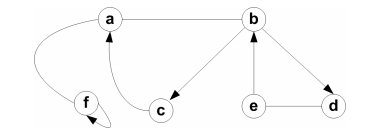
 

               594_Trees and Graphs.png


(b) Briefly state the differences between a sparse and a dense graph, and the mathematical property for each. Also, explain whether a sparse or dense graph is best implemented using and adjacency matrix and why.


Related Discussions:- Trees and graphs

Universality problem, The Universality Problem is the dual of the emptiness...

The Universality Problem is the dual of the emptiness problem: is L(A) = Σ∗? It can be solved by minor variations of any one of the algorithms for Emptiness or (with a little le

Automaton for finite languages, We can then specify any language in the cla...

We can then specify any language in the class of languages by specifying a particular automaton in the class of automata. We do that by specifying values for the parameters of the

Convert chomsky normal form into binary form, Suppose G = (N, Σ, P, S) is a...

Suppose G = (N, Σ, P, S) is a reduced grammar (we can certainly reduce G if we haven't already). Our algorithm is as follows: 1. Define maxrhs(G) to be the maximum length of the

REGULAR GRAMMAR, Find the Regular Grammar for the following Regular Express...

Find the Regular Grammar for the following Regular Expression: a(a+b)*(ab*+ba*)b.

Data retriving, i have research method project and i meef to make prposal w...

i have research method project and i meef to make prposal with topic. If this service here please help me

Strictly 2 - local automata, We will assume that the string has been augmen...

We will assume that the string has been augmented by marking the beginning and the end with the symbols ‘?' and ‘?' respectively and that these symbols do not occur in the input al

Generalization of the interpretation of local automata, The generalization ...

The generalization of the interpretation of strictly local automata as generators is similar, in some respects, to the generalization of Myhill graphs. Again, the set of possible s

Kleenes theorem, All that distinguishes the de?nition of the class of Regul...

All that distinguishes the de?nition of the class of Regular languages from that of the class of Star-Free languages is that the former is closed under Kleene closure while the lat

Write Your Message!

Captcha
Free Assignment Quote

Assured A++ Grade

Get guaranteed satisfaction & time on delivery in every assignment order you paid with us! We ensure premium quality solution document along with free turntin report!

All rights reserved! Copyrights ©2019-2020 ExpertsMind IT Educational Pvt Ltd