The fire triangle, Science

Assignment Help:

The Fire Triangle

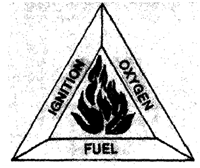
Generally, a fire needs three things to burn:

Fuel - something to bum, e.g.oi1.

Oxygen - to maintain combustion.

Ignition - something to start the fire, e.g. excessive heat, electrical spark, etc. This principle can be depicted in the form of a triangle as shown in Figure.
657_The fire triangle.png

Figure: The fire triangle.

By removing any one of the three sides of the triangle, fire is prevented. For example, many fires obtain oxygen from the air where it is about 20% by volume. Fire extinguishers, e.g. sand or foam (subsection 12.4.2), prevent oxygen being available to the fuel or ignition source. Although air is the most common source of oxygen, other sources are,

  • chlorates
  • permanganates
  • nitrates
  • peroxides
  • dichromates
  • other oxidising agents

The essence of fire prevention is to prevent the formation of fire triangle.

With air containing oxygen all around us, this consists primarily of keeping fuel and ignition sources apart.


Related Discussions:- The fire triangle

Explain the mechanics of respiration, Explain the Mechanics of Respiration ...

Explain the Mechanics of Respiration The process of respiration can be well understood by studying the mechanism of respiration. This can be explained through a respiratory cy

Determine the most important soil animals, Explain why earthworms are said ...

Explain why earthworms are said to be the most important soil animals. Earthworms ingest organic matter as well as soil where they mix, granulate and excrete to increase stabil

Fine chemical production, These are the case studies that will be used to p...

These are the case studies that will be used to partly assess your taught elements of Fine Chemical Production. There were lectures mainly dealing with the scale up of equipment th

Explain the adrenocorticotropic hormone (acth), Explain the Adrenocorticotr...

Explain the Adrenocorticotropic Hormone (ACTH) ACTH, also known as corticotrophin, is a polypeptide and is synthesized by corticotroph cells of the anterior pituitary gland. It

Explain the urea cycle, Explain the Urea Cycle ? From our discussion a...

Explain the Urea Cycle ? From our discussion above, it is clear that the amino group of all amino acids is ultimately converted to ammonia (NH3). Ammonia is highly toxic to th

How to organise an interaction session, HOW TO ORGANISE AN INTERACTION SESS...

HOW TO ORGANISE AN INTERACTION SESSION: How should we begin? What are the norms? What is the time slot? Any assessment criteria? These and many such questions may be coming to you

Determine the role of time in soil formation, Determine the role of Time in...

Determine the role of Time in soil formation Time plays a very important role in the soil formation as it provides for the soil forming processes to act and cause significant c

Water borne diseases, Water Borne Diseases: Diseases like cholera and t...

Water Borne Diseases: Diseases like cholera and typhoid, as well as diarrhoea and dysentery,  are spread through water. Germs of  these diseases multiply in the gut of  the inf

Write Your Message!

Captcha
Free Assignment Quote

Assured A++ Grade

Get guaranteed satisfaction & time on delivery in every assignment order you paid with us! We ensure premium quality solution document along with free turntin report!

All rights reserved! Copyrights ©2019-2020 ExpertsMind IT Educational Pvt Ltd