Sorting using interconnection networks, Computer Networking

Assignment Help:

The combinational circuits use the comparators for comparing the storing and number them on the basis of minimum and maximum functions. Likewise, in the interconnection networks the two processors perform the computation of minimum and maximum functions in the following way:

Let us consider there are two processors pj and pi. Each of these processors has been given as input a part of the sequence, say ej and ei. Now, the processor pi sends the element ei to pj and processor pj sends ej to pi. After that, processor pi determine the minimum of ei and ej i.e., min (ei,ej) and processor pj determine the maximum of ei and ej, i.e. max (ei,ej). The above method is called as compare-exchange and it has been depicted in the Figure .
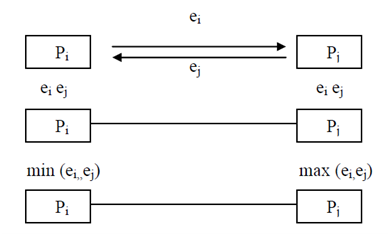
581_Illustration of Exchange-cum-Comparison in interconnection networks.png

                                                          Illustration of Exchange-cum-Comparison in interconnection networks

 The sorting problem chosen is bubble sort and the interconnection network can be depicted as n processors interconnected with each other in the type of a linear array as given in Figure. The method adopted for solving the bubble sort is called as odd- even transposition. Suppose an input series is B=(b1, b2, b3, b4......... bn) and each number is assigned to a particular processor. In the odd-even transposition,the sorting is executed with the help of two phases known as odd phase and even phase. In the odd phase, the elements stored in (p1, p2), (p3, p4), (p5, p6)......... (pn-1, pn) are compared according to the Figure and consequently exchanged if required i.e. if they are out of sort. In the even phase, the elements stored in (p2, p3), (p4, p5), (p6, p7)......... (pn-2, pn-1) are compared according to the Figure and consequently exchanged if required, i.e. if they are out of order. keep in mind, in the even phase the elements stored in p1 and pn are not exchanged and compared. The total number of phases needed for sorting the numbers is n i.e. n/2 odd phases and n/2 even phases. The algorithmic representation of the above discussed odd- even transposition is given below:

2084_Interconnection network in the form of a Linear Array.png

                                                Interconnection network in the form of a Linear Array


Related Discussions:- Sorting using interconnection networks

Root dns servers - application layer , Root DNS Servers A root  server...

Root DNS Servers A root  server is a serve which  consists of the entire  hierarchy  of servers. A root  server  usually  does not  store any  information  about  domains  but

Reference models - fundamentals of networks, Reference models Design...

Reference models Designing  implementing and  manufacturing  computer  networks  and related  devices  are very  complex  activities. Therefore in order  for this  technolog

Define what is the mac address, When you move the NIC cards from one PC to ...

When you move the NIC cards from one PC to another PC, does the MAC address gets transferred as well? Yes, that's because MAC addresses are hard-wired into the NIC circuitry, n

Nfs best performance, what parameters should i have for the best nfs v4 per...

what parameters should i have for the best nfs v4 performance?

What are reasons behind using layered protocols, What are reasons behind us...

What are reasons behind using layered protocols  Reasons for using layered protocols, using them leads to breaking up design problem into smaller more manageable pieces and lay

Explain classification of computer network by range, Question 1 Explain cl...

Question 1 Explain classification of computer Network by range Question 2 Explain three major problems of Transmission lines Question 3 What is the maximum data rate of

Selective repeat (sr) - transport layer, Selective Repeat (SR) Select...

Selective Repeat (SR) Selective repeats is a connection oriented protocols  in which  transmitter and receiver have a window  of sequence numbers. SR scheme  avoids  the  unne

Challenge handshake authentication protocols (chap), Challenge Handshake Au...

Challenge Handshake Authentication Protocols (CHAP) CHAP as its an implies implements  a form of authentication that  requires a challenge  and a response. A CHAP authenticator

Example on multiplicative decrease, Q. Example on Multiplicative Decrease? ...

Q. Example on Multiplicative Decrease? w = 1 for (each new ACK received) w = w+1 until (loss detected or w >= ssthresh) Not so slow - Exponential increase

Write Your Message!

Captcha
Free Assignment Quote

Assured A++ Grade

Get guaranteed satisfaction & time on delivery in every assignment order you paid with us! We ensure premium quality solution document along with free turntin report!

All rights reserved! Copyrights ©2019-2020 ExpertsMind IT Educational Pvt Ltd