Sorting using combinational circuit, Computer Networking

Assignment Help:

Now, let us suppose a famous sequence called as bitonic sequence and sort out the elements using a combinational circuit consisting of a set of comparators. The property of bitonic sequence is as follows:

Consider a series X= x0, x1, x2, x3, x4 ................... xn-1 such that condition 1:either x0, x1, x2, x3, x4 ................... xi is a monotonically increasing sequence and xi+1, xi+2,  ................... xn-1  is a monotonically decreasing sequence or condition 2: there exists a cyclic shift of the series  x0, x1, x2, x3, x4 ................... xn-1 such that the resulting series satisfies the condition 1.

Let us take a few examples of bitonic series: B1= 4,7,8,9,11,6,3,2,1 is bitonic series

B2= 12,15,17,18,19,11,8,7,6,4,5 is bitonic series

In order to give a solution to such a bitonic sequence, various phases of comparators are needed. The basic approach followed for solving such a difficulty is as given:

 Let us say we have a bitonic series X= x0, x1, x2, x3, x4 ................... xn-1 with the property that first n/2 elements are monotonically increasing elements are monotonically increasing like x0< x1< x2< x3< x4 ... xn/2+1> ...>xn-1.  After that, these patterns are compared with the help of a comparator as follows:

Y= min(x0, xn/2), min(x1, xn/2+1), min(x2, xn/2+2), ............. Min (xn/2-1, xn-1)

Z= max(x0, xn/2), max (x1, xn/2+1), max (x2, xn/2+2), ............. max (xn/2-1, xn-1)

After the above discussed iteration, the two new bitonic series are produced and the method is called as bitonic split. After that, a recursive operation on these two bitonic sequences is processed until we are able to achieve the sorted list of elements. The exact algorithm for sorting the bitonic series is as follows:

Sort_Bitonic (X)

// Input: N Numbers following the bitonic property

// Output: Sorted List of numbers

1) The Sequence, i.e. X is transmitted on the input lines of the combinational circuit which consists of a variety of set of comparators.

2) The sequence X is divided into two sub-bitonic series say, Y and Z, with the help of a method known as bitonic split.

3) Recursively implements the bitonic split on the sub series, i.e. Y and Z, until the size

Of subsequence reaches to a level of 1.

1) The sorted series is achieved after this level on the output lines.

With the help of a diagram to demonstrate the concept of sorting using the comparators.

Example 1: Consider a unsorted list having the element values as

{3,5,8,9,10,12,14,20,95,90,60,40,35,23,18,0}

List is to be sorted in ascending order. To sort this list, in the first stage comparators of order 2 (i.e. having 2 input and 2 output) will be used. Similarly, 2nd stage will consist of 4, input comparators, 3rd stage 8 input comparator and 4th stage a 16 input comparator.

Let us consider an example with the help of a diagram to illustrate the concept of sorting using the comparators.
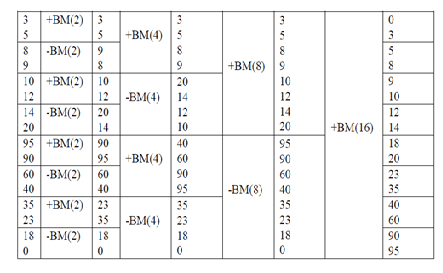
1875_Sorting using Combinational Circuit.png

                                                          Sorting using Combinational Circuit


Related Discussions:- Sorting using combinational circuit

Discuss the benefits and requirements of voip, Question 1 Discuss the bene...

Question 1 Discuss the benefits and requirements of VOIP Question 2 Define the following Multicast routing protocol explain in detail with diagram Multicast backbone

Require class and how many different types of class exists, Why do we requi...

Why do we require class and how many different parts of class exists?

Three main functions at layer three of the osi model, Identify the 3 major ...

Identify the 3 major functions at layer 3 of the OSI model Ans) Layer three explains the path, forwards the packet and executes software / logical addressing.

State the example of security audit as case study, State the Example of sec...

State the Example of security audit as case study Linda narrates one of her experience about a security audit. She was performing a spot audit where she was checking certain

What is dns, What is DNS? DNS is Domain Name System. The major f...

What is DNS? DNS is Domain Name System. The major function of this network service is to provide host names to TCP/IP address resolution.

Programming based on data parallelism, Programming Based on Data Parallelis...

Programming Based on Data Parallelism In a data parallel programming model, the focus is on data distribution. Every processor works with a portion of data. We shall discuss on

User datagram protocol, A UDP header does not have Sequence number and Ackn...

A UDP header does not have Sequence number and Acknowledgement number fields. Is it an advantage or a disadvantage? Explain your answer in detail. User Datagram Protocol Th

State the benefits of infrared light, State the benefits of Infrared light ...

State the benefits of Infrared light Infrared light does not penetrate walls or other opaque objects. This has two benefits: First, infrared communications can be more simply

Role of software in intranet, Role of Software in Intranet For an Intr...

Role of Software in Intranet For an Intranet to be successful, it must have strong software support. In this section, a brief description of the operating system, groupware an

Categories of address forms, Categories of address forms: STATIC: ...

Categories of address forms: STATIC:  In this type the hardware manufacturer gives permanent physical address to every network manufacturer and interface must ensure th

Write Your Message!

Captcha
Free Assignment Quote

Assured A++ Grade

Get guaranteed satisfaction & time on delivery in every assignment order you paid with us! We ensure premium quality solution document along with free turntin report!

All rights reserved! Copyrights ©2019-2020 ExpertsMind IT Educational Pvt Ltd