Root of function, Mathematics

Assignment Help:

Root of function: All throughout a calculus course we will be determining roots of functions.  A root of function is number for which the function is zero.  In other terms, determining the roots of a function, g(x), is equal to solving

                                                      g ( x ) = 0

Example: Find out all the roots of

                       f (t ) = 9t 3 -18t + + 6t

Solution :

Thus we will have to solve,

9t 3 -18t 2 + 6t = 0

Firstly, we have to factor the equation as much as possible.  Doing this gives,

                                  3t (3t 2 - 6t + 2) = 0

Next if a product of two things are zero then one (or both) of them must be zero. It means that,

                  3t = 0         OR,

                   3t 2 - 6t +2 = 0

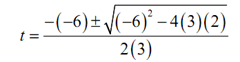
From the first it's apparent that one of the roots have to then be t=0. To get the remaining roots we will have to use the quadratic formula on the second equation.  Doing this gives,
1147_function notation.png

= (6±√12 )/6

= (6±√(4)(3)) /6

= (6±2√3)/6

=3±√3/3

=1±(1/3) √3

= 1±1/√3

In order to remind you how to make simpler radicals we gave various forms of the answer.

To calculate the problem, following is a complete list of all the roots of this function.

                                  t = 0, t =( 3 + √3 )/3 , t = (3 -  √3 )/3

Note we didn't employ the final form for the roots from the quadratic. It is usually where we'll stop along with the simplification for these types of roots.  Also note that, for practice, we broke up the compact form for the two roots of the quadratic.  You will have to be able to do this so ensure that you can.

This example had a couple of points other than determining roots of functions.

The first was to remind you of the quadratic formula. it won't be the last time that you'll required it

The second was to get you utilized to seeing "messy" answers.  Actually, the answers in the above list are not that messy.  Though, most of the students come out of an Algebra class very habitual to seeing only integers and the occasional "nice" fraction as answers.

Hence, here is fair warning .In "real life" (whatever that is) the answer is hardly ever a simple integer such as two.  In most of the problems the answer will be a decimal that came about from a messy fraction and/or an answer that involved radicals.


Related Discussions:- Root of function

#algebra 2 .., encoded with the matrix -3 -7 and 4 9. what lights up a socc...

encoded with the matrix -3 -7 and 4 9. what lights up a soccer stadium? ecoded message: {-3 - 7} {3 2 } {3 6} {57 127} {52 127} {77 173} {23 51)

.probability, a box contains 4 white and 6 green balls.Two balls are drawn ...

a box contains 4 white and 6 green balls.Two balls are drawn randomly with replacement.Show the probability on tree dig.

Partial differential equations, I need expert who can solve 10 set of PDE w...

I need expert who can solve 10 set of PDE with constant of integration.

What was the original price of the coat before tax, Nick paid $68.25 for a ...

Nick paid $68.25 for a coat, including sales tax of 5%. What was the original price of the coat before tax? Since 5% sales tax was added to the cost of the coat, $68.25 is 105%

Give an examples of simplifying fractions , Give an examples of Simplifying...

Give an examples of Simplifying Fractions ? When a fraction cannot be reduced any further, the fraction is in its simplest form. To reduce a fraction to its simplest form,

Math, a business is owned by three people.the first owns 1/12 of the busine...

a business is owned by three people.the first owns 1/12 of the business and the second owns 1/6 of the business. what fractional part of the business is owned by the third person

Multiple integrals, how to convert multiple integral into polar form and ch...

how to convert multiple integral into polar form and change the limits of itegration

Substitution rule, Substitution Rule ∫ f ( g ( x )) g′ ( x ) dx = ∫ f (...

Substitution Rule ∫ f ( g ( x )) g′ ( x ) dx = ∫ f (u ) du,     where, u = g ( x ) we can't do the following integrals through general rule. This looks considerably

Square the next consecutive integer find the lesser integer, The square of ...

The square of one integer is 55 less than the square of the next consecutive integer. Find the lesser integer. Let x = the lesser integer and let x + 1 = the greater integer. T

Write Your Message!

Captcha
Free Assignment Quote

Assured A++ Grade

Get guaranteed satisfaction & time on delivery in every assignment order you paid with us! We ensure premium quality solution document along with free turntin report!

All rights reserved! Copyrights ©2019-2020 ExpertsMind IT Educational Pvt Ltd