Risk breakdown structure for a project , Project Management

Assignment Help:

Risk Breakdown Structure for a Project 

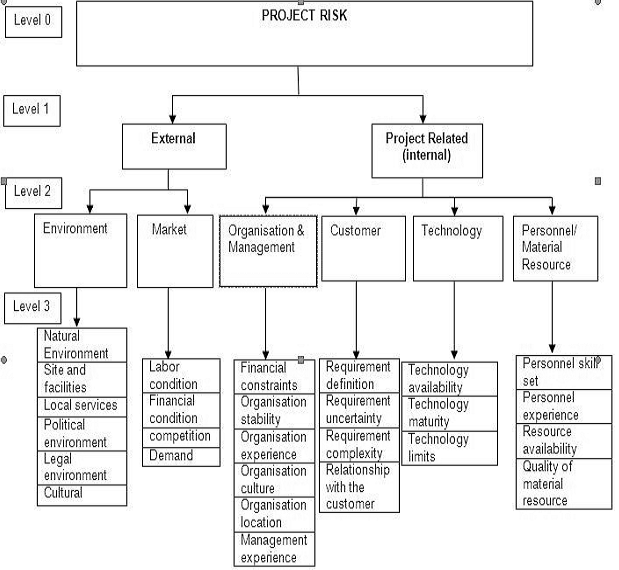
Risk Breakdown Structure (RBS) is a hierarchical list of risks, which standardises the department's personnel resources that help in planning and controlling the project work. It also helps to identify and manage the project risks. 

In a project, which has more number of risks, you can define different risk breakdown structures for each separate task. Each risk is differentiated by its time of occurrence, chance of occurrence and outcome. This kind of project also has a number of risk templates, which are the standard set of risk breakdown structures that allow you to easily add risks to the projects. These kinds of templates are always included in the projects with more number of risks. You can also create your own template and use it in your project. The total resources make the Level 1 in the hierarchies, and each subsequent level makes sub-level of the resource category. Each lower level represents a detailed description of the resource, which helps plan, monitor and control the work.

Each project has its Risk Breakdown Structure (RBS). The RBS benefits the people engaged in risk identification process by reminding them of the possible risk areas to think about. It provides an input to Qualitative Risk. 

The Figure is the Risk Breakdown Structure for a generic project which explains each level with examples.  
934_Risk breakdown structure.png

Figure : Risk Breakdown Structure for Generic Project 

Analysis of each risk can be done whereby impacts are assigned as numeric or as High, Medium and Low. Risks are then prioritised according to the affects it causes in the Project's success.  


Related Discussions:- Risk breakdown structure for a project

Element of total quality management, In order to adopt and initiate TQM ...

In order to adopt and initiate TQM within any organization it is necessary to understand the key elements. These elements which form the essential core of the TQM phil

Functional project structure, QUESTION (a) The project lifecycle refers...

QUESTION (a) The project lifecycle refers to a logical sequence of activities to accomplish the project's goals and objectives. Regardless of the scope or complexity any projec

What are the major characteristics of a project, Question : (a) Organi...

Question : (a) Organizations and individuals have studied a number of projects that have both succeeded and failed and some common factors emerge. Can you give some reasons fo

Explain how culture influences global product development, Question 1: ...

Question 1: (a) Critically evaluate joint venture and licensing as global market entry methods. (b) Explain and illustrate how a geocentric approach to global marketing i

Factors can make competitive rivalry between organisation, DF Company, a re...

DF Company, a relatively new company, is in the business of designing and building farm equipment and machinery. Whilst it has been winning in its first few years of operation, sal

Bidding , Bidding is a process in which you  quote money in exchange of go...

Bidding is a process in which you  quote money in exchange of goods or services through an auction. They are two types of auctions: open auction and silent auction. In an open auc

Analysis the production in manufacturing company, Analysis The factory...

Analysis The factory has the process for the following:  QC of sampling,  receiving orders,  receiving fabrics and accessories,  checking of fabrics,  drawing,  cutting,  sort

What do you meant by change of scope in a project, Question: (a) (i) Wh...

Question: (a) (i) What do you meant by "a change of scope" in a project? (ii) Unplanned changes (for e.g, unplanned expenses) might occur during the implementation phase of

Second elaboration iteration, Perform a status assessment of the second Ela...

Perform a status assessment of the second Elaboration iteration. DO NOT GENERALISE. Assess each activity separately against the outcomes specified for the activity. Generate a deta

Identify characteristics of effective project team members, Question 1: ...

Question 1: (a) Identify and explain the major roles of a Project Manager with illustrations where necessary. (b) Identify and Explain the different types of Project Organ

Write Your Message!

Captcha
Free Assignment Quote

Assured A++ Grade

Get guaranteed satisfaction & time on delivery in every assignment order you paid with us! We ensure premium quality solution document along with free turntin report!

All rights reserved! Copyrights ©2019-2020 ExpertsMind IT Educational Pvt Ltd