Program to find interest on bank deposits, COBOL Programming

Assignment Help:

PROGRAM TO FIND INTEREST ON BANK DEPOSITS:

We have to write a program to find interest on deposits. The criteria is given below :
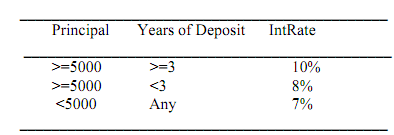
960_PROGRAM TO FIND INTEREST ON BANK DEPOSITS.png

identification division.

program- id.

environment division.

input-output section.

file-control.

  select bankfile assign to disk

  organization is line sequential.

data division.

file section.

fd bankfile  

  label records are standard

  value of file- id is "bank.dat".

01 bankrec.

  02 dno   pic 9(5).

  02 dname pic x(21).

  02 p     pic 9(4)v9(2).

  02 n     pic 9(2).

working-storage section.

01   ans pic x value space.

01   tot pic 9(6)v9(2) value 0.

01   int pic 9(6)v9(2) value 0.

01   key- in pic x value space.

01 r pic 9(2) value 0.

01 head-1 pic x(80) value all '-'.

01 head-2.

02  f pic x(8) value "Deps No".

    02  f pic x(3) value spaces.

    02  f pic x(10) value "Deps Name".

    02  f pic x(5) value spaces.

    02  f pic x(8) value "Deposit".

    02  f pic x(5) value spaces.

    02  f pic  x(8) value "Period".

    02  f pic x(5) value spaces.

    02  f pic x(5) value "Rate".

    02  f pic x(5) value spaces.

    02  f pic x(8) value "Interest".

    02  f pic x(10) value "  Nett".

  01  head-3.

    02  e-dno  pic z(5).

    02  e-dname pic x(26).

    02  e-p  pic  z(4).z(2).

  02  f pic x(5) value spaces.

  02  e-n  pic z(2).

  02  f pic x(5) value spaces.

  02  e-r pic z(2).

  02  f pic x(3) value spaces.

  02  e-int  pic z(4).z(2).

  02  f pic x(3) value spaces.

  02  e-tot pic z(6).z(2).

procedure division.

p-1.

  open output bankfile.

  perform g-w-para until ans = 'N' or 'n'.

  close bankfile.

  open input bankfile.

  display(1 1) erase.

  display head-1.

  display head-2.

  display head-1.

read-para.

  read bankfile at end go to close-para.

  if ( p not < 5000 and n not < 3 )

    move 10 to r

    compute tot = p * (1 +  r / 100) ** n.

  if ( p not < 5000 and n < 3)

    move 8 to r

    compute tot = p * (1 +  r / 100) ** n.

  if ( p < 5000)

    move 7 to r    

    compute tot = p * (1 + r / 100) ** n.

  move tot to e-tot.

  compute int = tot - p.

  move int to e- int.

  move dno to e-dno.

  move dname to e-dname.

  move p to e-p.

  move n to e-n.

  move r to e-r.

  display head-3.

  go to read-para.

close-para.

  display head-1.

  close bankfile.

  stop run.

g-w-para.

  display(1 1) erase.  

  display(3 5) "Dep No : ".

  accept dno.

  display(5 5) "Dep Name : ".

  accept dname.

  display(7 5) "Amount : ".

  accept p.

  display(9 5) "Years : ".

  accept n.

  write bankrec.

  display(15 5) "Add more [y/n] : ".

  accept ans.


Related Discussions:- Program to find interest on bank deposits

Sequential files with the variable-length records, SEQUENTIAL FILES WITH TH...

SEQUENTIAL FILES WITH THE VARIABLE-LENGTH RECORDS: The Magnetic - tape or disk files can hold variable-length records. In this situation the file can have records with various

Rules of read statements, Rules of read statements: The next record is...

Rules of read statements: The next record is identified according to the rules as shown below: (i) Whenever the READ NEXT statement is the initial statement to be executed

File-control paragraph for the indexed files, FILE-CONTROL paragraph for th...

FILE-CONTROL paragraph for the indexed files: The common format for the SELECT clause for a file is as shown below: SELECT  file-name  ASSIGN   TO  implementor -name

Write statement - relative files, WRITE Statement:      The WRITE stat...

WRITE Statement:      The WRITE statement for a relative file has the format which is as shown below.          WRITE  record-name   [ FORM   identifier ]

Declarative and file status clause, DECLARATIVE and FILE STATUS Clause: ...

DECLARATIVE and FILE STATUS Clause: The input-output exception condition in the situation of a direct access files can be handled by a declarative procedure in a manner simila

#title.cobol help , we have input file ,record layout is EMP ID (6 char) , ...

we have input file ,record layout is EMP ID (6 char) , EMP NAME (20 char), Designation (3 char),Salary (5 digit) Base Branch (10char) Grade (3 Alphanumeric). This is the input file

Blank insertion and zero insertion, B (Blank Insertion) : The occurren...

B (Blank Insertion) : The occurrence of a B anyplace in the picture will insert a space character in the edited data. There can be more than one B in the picture. Examples:

Perform with times option, PERFORM WITH TIMES OPTION: The format of ...

PERFORM WITH TIMES OPTION: The format of a PERFORM TIMES statement is as shown below: Illustration:   A)  Perform the para-2 5 times. In this situation the specifie

File characteristics, FILE CHARACTERISTICS: The task of file handling ...

FILE CHARACTERISTICS: The task of file handling is the responsibility of the system software termed as IOCS (Input-Output control system). Record Size: We know that th

Why 77 level used for, 77 level used for- It is Elementary level item. it C...

77 level used for- It is Elementary level item. it Cannot be subdivisions of other items or cannot be qualified, or they can be subdivided themselves.

Write Your Message!

Captcha
Free Assignment Quote

Assured A++ Grade

Get guaranteed satisfaction & time on delivery in every assignment order you paid with us! We ensure premium quality solution document along with free turntin report!

All rights reserved! Copyrights ©2019-2020 ExpertsMind IT Educational Pvt Ltd