Program insertion of a node into any circular linked list, Data Structure & Algorithms

Assignment Help:

Program Insertion of a node into any Circular Linked List

Figure depicts a Circular linked list from which an element was deleted.

ALGORITHM (Deletion of an element from a Circular Linked List)

Step 1  Begin

Step 2  if the list is empty, element cannot be eliminated.

Step 3  else, if element desire  to be deleted at first node, then make the start (head) to point to the second element.

Step 4  else, Removeelement from the list by calling find function & returning the found address of the element.

Step 5  End.
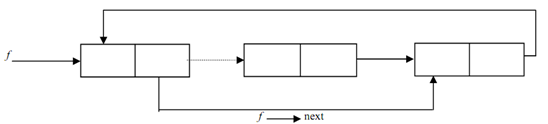
2108_Program Insertion of a node into any Circular Linked List.png

Figure: A Circular Linked List through which an element was deleted

(Dotted line indicates the linked that existed prior to deletion)

Program demonstrated the code for the deletion of an element from the Circular linked list.

#include

#include

#define NULL 0

structlinked_list

{

int data;

structlinked_list *next;

};

typedefstructlinked_listclist;

clist *head, *s;

/* prototype of find and delete_function*/

clist * delete_clist(clist *);

clist * find(clist *, int);

/*description of delete_clist      */

clist *delete_clist(clist *start)

{

int key; clist * f, * temp;

printf("\n enter the element to be deleted \n");

scanf("%d", &key);

if(start->data == key)

{

temp=start->next; free(start);

start=temp;

}

else

{

f = find(start,key);

if(f==NULL)

printf("\n key not fund");

else

{

}

}

temp = f->next->next;

free(f->next);

f->next=temp;


return(start);

}

/*description of find function */

clist * find(clist *start, int key)

{

if(start->next->data == key)

return(start);

if(start->next->next == NULL)

return(NULL);

else

find(start->next, key);

}

void main()

{

voidcreate_clist(clist *);

int count(clist *);

void traverse(clist *);

head=(clist *)malloc(sizeof(clist));

s=head;

create_clist(head);

printf(" \n traversing the created clist and the starting address is %u \n", head);

traverse(head);

printf("\n number of elements in the clist   %d \n", count(head));

head=delete_clist(head);

printf(" \n traversing the clist after delete_clistand starting address is following %u \n",head);

traverse(head);

}

voidcreate_clist(clist *start)

{

printf("inputthe element -1111 for coming out of loop\n");

scanf("%d", &start->data);

if(start->data == -1111)

start->next=s;

else

{

start->next=(clist*)malloc(sizeof(clist));

create_clist(start->next);

}

}

void traverse(clist *start)

{

if(start->next!=s)

{

printf("data is %d \t next element address is %u\n", start->data,  start- traverse(start->next);

}

}

if(start->next == s)

printf("data is %d \t next element address is %u\n",start->data,   start->next);

int count(clist *start)

{

if(start->next == s)

return 0;

else

}

return(1+count(start->next));

Program: Deletion of an element from the circular linked list


Related Discussions:- Program insertion of a node into any circular linked list

Data structures, Aa) Come up with an ERD from the following scenario, clear...

Aa) Come up with an ERD from the following scenario, clearly stating all entities, attributes, relationships before final sketch of the ERD: [50 m

Creation of a linked list, Program: Creation of a linked list In the ne...

Program: Creation of a linked list In the next example, wewill look to the process of addition of new nodes to the list with the function create_list(). #include #includ

Advantages of first in first out method, Advantages of First in First out (...

Advantages of First in First out (FIFO) Costing Advantages claimed for first in first  out (FIFO)  costing method are: 1. Materials used are drawn from the cost record in

Find a minimum cost spanning arborescence rooted, Find a minimum cost spann...

Find a minimum cost spanning arborescence rooted at r for the digraph shown below, using the final algorithm shown in class. Please show your work, and also give a final diagram wh

Disadvantages of the lifo costing method, The disadvantages or limitations ...

The disadvantages or limitations of the last in first out costing method are: The election of last in first out for income tax purposes is binding for all subsequent yea

Terminology used for files structures, Given are the definitions of some im...

Given are the definitions of some important terms: 1) Field: This is an elementary data item characterized by its size, length and type. For instance, Name

Space-complexity of the algorithm, The space-complexity of the algorithm is...

The space-complexity of the algorithm is a constant. It just needs space of three integers m, n and t. Thus, the space complexity is O(1). The time complexity based on the loop

A sort which relatively passes by a list, A Sort which relatively passes by...

A Sort which relatively passes by a list to exchange the first element with any element less than it and then repeats with a new first element is called as      Quick sort.

Encryption the plain-text using the round keys, Encryption the plain-text u...

Encryption the plain-text using the round keys: 1. (Key schedule) Implement an algorithm that will take a 128 bit key and generate the round keys for the AES encryption/decryp

Implementation of queue using a singly linked list, Implementation of queue...

Implementation of queue using a singly linked list: While implementing a queue as a single liked list, a queue q consists of a list and two pointers, q.front and q.rear.

Write Your Message!

Captcha
Free Assignment Quote

Assured A++ Grade

Get guaranteed satisfaction & time on delivery in every assignment order you paid with us! We ensure premium quality solution document along with free turntin report!

All rights reserved! Copyrights ©2019-2020 ExpertsMind IT Educational Pvt Ltd