Premium, Financial Management

Assignment Help:

The amount by which the market price exceeds the conversion value or the investment value called the premium. When expressed as a percentage, it is given by,

         Conversion premium = (Market Price - Conversion value)/Conversion value x 100

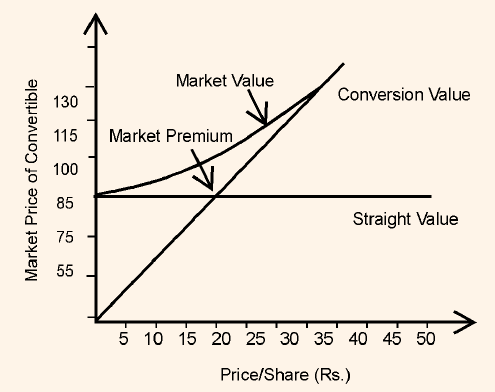
The conversion value can be lower than or greater than the investment value. Irrespective of this, the premium exists. This may be due to the investor's expectations that in future, the underlying stock may experience a price rise. These relationships can be better understood from Figure 1.

Figure 1
255_premium.png

From Figure 1, we observe that the investment value serves as a floor for the price of the convertible security, in a scenario of price decline of the underlying stock. When the market price of the stock exceeds certain value, the conversion value exceeds the investment value. The market value of the convertible security on most occasions exceeds its conversion value and investment value. The market premium is greatest at the point of intersection of the investment value and the conversion value.

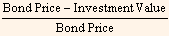
In the above figure, we could understand the changes in the market price of the convertible with respect to conversion and investment values figuratively. If we express these relationships in relative terms, we have the following ratios:

Premium over Conversion Value = 432_premium1.png
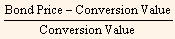
Premium over Investment Value = 532_premium2.png


Related Discussions:- Premium

Explain hedging transaction exposure, Discuss and compare hedging transacti...

Discuss and compare hedging transaction exposure by using the forward contract vs. money market instruments. While do the alternative hedging approaches generate similar result?

Define limit of theory of comparative advantage is realistic, What consider...

What considerations might limit the extent to which the theory of comparative advantage is realistic? Answer: The theory of relative advantage was initially advanced by the ninet

Capital market, Capital market: The term capital market is used to deno...

Capital market: The term capital market is used to denote all the activities of the primary and secondary markets. It can also refer to the market for equity and debt instrumen

Opposite project - net present value, A company has the opportunity to sell...

A company has the opportunity to sell an old machine. The machine is fully depreciated to a zero book value but could be sold for $5,000. If the company did not sell the machine, i

Source documents of an accounting system, Source documents of an accounting...

Source documents of an accounting system: Source documents are those documents that identify the particular transaction that is being recorded.  They act as an internal control

Medium-term notes (mtns) , Medium-term notes are debt instrumen...

Medium-term notes are debt instruments that can be offered continuously to an investor. An agency of the issuer offers these; and these are avai

What is the de-merger, What is the De-merger This is splitting up of a ...

What is the De-merger This is splitting up of a group into two or more separate bodies. The group is split into separate entities, but the shareholders remain the same. It is o

Effect of volatility and the arbitrage free value, The volatility ass...

The volatility assumption has a great influence on the arbitrage free value of the bond. The higher the expected volatility, the greater the value of an option. W

Cost principle - accounting principle, Cost Principle - Accounting Principl...

Cost Principle - Accounting Principle According to this principle all the non-monetary assets of the business are display in the books of accounts at the historical cost that

Write Your Message!

Captcha
Free Assignment Quote

Assured A++ Grade

Get guaranteed satisfaction & time on delivery in every assignment order you paid with us! We ensure premium quality solution document along with free turntin report!

All rights reserved! Copyrights ©2019-2020 ExpertsMind IT Educational Pvt Ltd