Partial input elasticity of output, Microeconomics

Assignment Help:

Partial Input Elasticity of Output: 

This is a short-run concept which deals with the variability of only one factor keeping the others constant. There are three kinds of returns: 

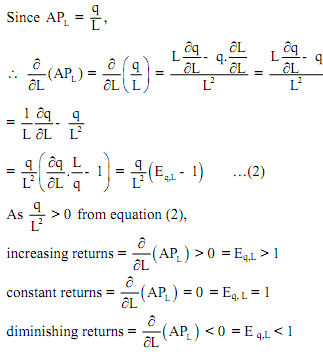
i) Increasing returns: when the AP of a factor rises and MP > AP 

ii) Constant returns: when AP is constant and MP = AP 

iii) Diminishing returns: when AP is falling MP < AP 

The concept of returns to a factor can also be expressed in terms of the "partial input elasticity of output".   

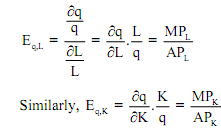
Partial input elasticity of output is also called elasticity of output with respect to a factor. It is the percentage change in output quantity for one per cent change in the quantity of a factor when all other factors remain constant.  

Elasticity of q with respect to L is given by,  
1629_Partial Input Elasticity of Output.png

let us now related this to return to scale
771_Partial Input Elasticity of Output1.png

Besides the above mentioned three returns, there can be another type known as the 'non-proportional returns to a variable factor'. Under it, initially, there is increasing returns to a factor up to a certain level beyond which there is diminishing returns.  


Related Discussions:- Partial input elasticity of output

Explain content of factor markets and distribution of income, Explain about...

Explain about the content of factor markets and the distribution of income. Content of factor markets and the distribution of income: a. Factor distribution of income b.

3rd degree price discrimination(monopoly), What is third degree price discr...

What is third degree price discrimination? Explain with case analysis,give two successful & unsuccessful cases of 3rd degree price discrimination.

Stoichiometry , Mg(OH)2 + 2HCl-----> MgCl2 +2H2O how many grams of magnesiu...

Mg(OH)2 + 2HCl-----> MgCl2 +2H2O how many grams of magnesium chloride can be produced from 14.60mL of a 0.546M hydrogen chloride solution?

Simple human capital model, Question 1: i) Use a simple human capital m...

Question 1: i) Use a simple human capital model to explain the rationale for undertaking higher education. ii) Why do some people vary significantly in the amounts of human

Compensated demand curve, Compensated Demand Curve: Compensated demand...

Compensated Demand Curve: Compensated demand function for a commodity (say x1) of an individual consumer represents demand quantity for that good (which is purchased by the co

Average product and marginal product, Average product and marginal product:...

Average product and marginal product: Average product (AP) is the output per unit of the variable factor employed. In other words, it is the productivity of the variable facto

Periodic table, Chemical properties of p block elements

Chemical properties of p block elements

Capital intensive operations, Where minimum efficient scale is very huge fo...

Where minimum efficient scale is very huge for capital intensive operations, it may be more cost effective to allow one company to spread its fixed costs over a very huge number of

Explain the long run incremental cost, Question: (a) Long Run Incremen...

Question: (a) Long Run Incremental Cost (LRIC) is considered as the "gold standard" for setting interconnection charges. Discuss the strengths and weaknesses of the three ap

Chapter 7, a firm has fixed costs of $60 and variable costs as indicated at...

a firm has fixed costs of $60 and variable costs as indicated at the bottom of this page. complete the table and check your calculations

Write Your Message!

Captcha
Free Assignment Quote

Assured A++ Grade

Get guaranteed satisfaction & time on delivery in every assignment order you paid with us! We ensure premium quality solution document along with free turntin report!

All rights reserved! Copyrights ©2019-2020 ExpertsMind IT Educational Pvt Ltd