Nested and split-plot designs, Science

Assignment Help:

1. How much variation is there in the routine analysis of fibre content of soya cotton cakes? The data are presented by the lab that did the test and the technician within the lab that did the analysis.

(Data from Clarke and Kempson)

To perform an appropriate analysis, you will need 3 columns, one for the responses, one indicating the lab and one indicating the technician. When specifying your model, remember that technicians are nested within labs (so you could number the technicians from 1 to 9 if you wanted). Write down the two null hypotheses. Check whether or not the assumption of normality is justified. Give a 2 or 3 sentence summary of your conclusions.
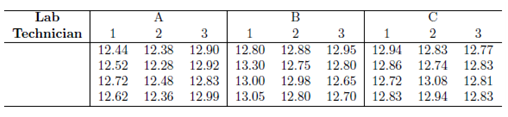
1907_table1.png

2. Commercial respirators include filters to protect against particulate matter. There are two manufacturers of such filters and three filters were selected at random from each manufacturer. Each filter was tested three times. \The measurements are the percent penetration by a standard type of aerosol." (from Kuehl, including data)
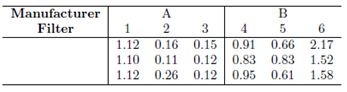
300_table2.png

(a) Using these data , write down the appropriate linear model.

(b) Compute the analysis of variance table, including the expected mean squares.

(c) Check for normality.

(d) As the assumption of normality is not satisfied, replace the responses by their ranks and repeat

the analysis on the ranks. Have your conclusions changed?

(e) Write a 1 or 2 sentence summary of your conclusions.

3. Montgomery (2007) describes an experiment to study pigment dispersion in paint. Four mixes of a pigment are used. Each day all four mixes are prepared and then applied to three panels with each panel receiving paint by one of three application methods (brush, roller, spray gun). The experiment is repeated on a second day. Perform an appropriate analysis and comment. (Hint: consider the paper tensile strength example.)
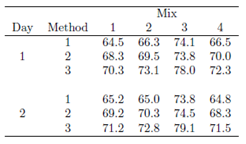
246_table3.png


Related Discussions:- Nested and split-plot designs

Water pressure changes with depth, Water pressure changes with depth Us...

Water pressure changes with depth Use the funnel and manometer which you made in the last experiment. Fill a tall glass jar or pail with water. Calculate the pressure just belo

Lasers in nonionising radiations, Lasers : Laser light is an extremely int...

Lasers : Laser light is an extremely intense form of electromagentic radiation and its name is acronym for light amplification by stimulated emission of radiation. Lasers are us

Methods of preventing or reducing soil erosion, What are the methods of pre...

What are the methods of preventing or reducing soil erosion? The methods of preventing or reducing soil erosion are: (i) Prevention of deforestation (ii) Plantation of tre

How cells join together, In a unicellular organism, the interior  region of...

In a unicellular organism, the interior  region of  the organism  is no longer in contact with the external environment.  Thus simple processes  of  diffusion, phagocytosis, exocyt

Explain the lubrication of food, Explain the Lubrication of food Dry fo...

Explain the Lubrication of food Dry food enters the mouth. It is moistened and lubricated by the saliva, before it can be made into a bolus ready for swallowing.

Explain types of steroids, Steroids are of many types . These are given be...

Steroids are of many types . These are given below: a)  Sterols :  Cholesterol, ergosterol. b)  Bile acids :  Glycocholic acid, taurocholic acid. c)  Hormones  :  Testoste

Iron age, Iron Age: We briefly surveyed the ideas and techniques of  th...

Iron Age: We briefly surveyed the ideas and techniques of  the early human beings, and traced the roots of  science in  the primitive culture. You also read about the emergence

Floating in different liquids, Floating in different liquids Obtain a t...

Floating in different liquids Obtain a tall, slender glass jar, test tube or bottle, and the following liquids: mercury, carbon tetrachloride, water and kerosene. You will also

Explain about the alluvial soils, Explain about the Alluvial soils All...

Explain about the Alluvial soils Alluvial soils are characterised by their extreme depth, often several hundred feet, and a grey or greyish brown colour. Their texture varies

Write Your Message!

Captcha
Free Assignment Quote

Assured A++ Grade

Get guaranteed satisfaction & time on delivery in every assignment order you paid with us! We ensure premium quality solution document along with free turntin report!

All rights reserved! Copyrights ©2019-2020 ExpertsMind IT Educational Pvt Ltd