Multiplication of binomials, Mathematics

Assignment Help:

To understand the multiplication of binomials, we should know what is meant by Distributive Law of Multiplication. Suppose that we are to multiply (a + b) and m. We treat (a + b) as a compound expression and m as a simple expression.  Therefore,  (a + b)m by definition will be:

         =       m + m + m + m + ....... taken a + b times

         =       (m + m + m + .... taken a times) + (m + m + m + ..... taken b times)

         =       am + bm

Similarly (a - b)m = am - bm and (a - b + c)m = am - bm + cm. This is referred to as Distributive Law of Multiplication and it says that the product of a compound expression by a simple expression is the algebraic sum of the partial products of each term of the compound expression by that simple expression.

         In the above, if we write (c + d) in place of m we will have

         (a + b)(c + d)    =              a(c + d) + b(c + d)

                                =              ac + ad + bc + bd

1. Multiply (3a + d) and (b + c).

We employ (a + b)(c + d) = a(c + d) + b(c + d)   = ac + ad + bc + bd. Therefore, (3a + d)(b + c)   = 3a(b + c) + d(b + c) = 3ab + 3ac + bd + cd. (This procedure can be extended to trinomials and polynomials also.)

2. Multiply 2a + 5c and 3d + 2b.

         One way of doing this is to employ (a + b)(c + d) = ac + ad + bc + bd

         That is,

         (2a + 5c)(3d + 2b) = 2a(3d + 2b) + 5c(3d + 2b)

                                   = 6ad + 4ab + 15cd + 10bc

In the second method, we position the binomials as we did in addition or subtraction and do the multiplication operation. That is,

                                      2a + 5c

(x)

3d + 2b


6ad + 15cd


+ 4ab  + 10bc


6ad + 15cd + 4ab + 10bc

This product is the same as one obtained earlier.

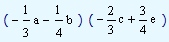
Multiply 1180_multiplication of binomials.png and 37_multiplication of binomials2.png

That is, we have to compute

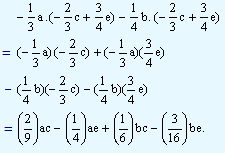
1242_multiplication of binomials3.png

We write this as

1089_multiplication of binomials4.png 

(Note: While multiplying fractions, numerators and denominators of given fractions are multiplied respectively and the product also being expressed as a fraction.)

  1. Add 3ac + 5bd - 7cd and ac - 5bd - 4cd

  3ac + 5bd - 7cd

(+)

ac - 5bd - 4cd
  4ac +  0  - 11cd
  1. Multiply 3a + 5b - 7d and c - 4e - 5

That is, we require (3a + 5b - 7d) x (c - 4e - 5)

= 3a (c - 4e - 5) + 5b (c - 4e - 5) - 7d(c - 4e - 5)

= 3ac - 12ae - 15a + 5bc - 20be - 25b - 7cd + 28de + 35d


Related Discussions:- Multiplication of binomials

Dora, dora and her family are driving to visit relatives for the holidays t...

dora and her family are driving to visit relatives for the holidays they travel 174 miles in 3 hours if they travel at a constant speed how many miles do they travel in one hourest

How many miles required to be driven for both services cost, Easy Rider tax...

Easy Rider taxi service charges a pick-up fee of $2 and $1.25 for each mile. Luxury Limo taxi service charges a pick-up fee of $3.25 and $1 per mile. How many miles required to be

Word problems, please can you help me with word problems

please can you help me with word problems

Determine the critical points, Assume that the amount of money in a bank ac...

Assume that the amount of money in a bank account after t years is specified by, Find out the minimum & maximum amount of money in the account throughout the first 10 years

Diffrentiation, y=f(a^x)   and f(sinx)=lnx find dy/dx Solution) dy/dx...

y=f(a^x)   and f(sinx)=lnx find dy/dx Solution) dy/dx = (a^x)(lnx)f''(a^x), .........(1) but f(sinx) = lnx implies f(x) = ln(arcsinx) hence f''(x) = (1/arcsinx) (1/ ( ( 1-x

Determine the length of the rectangle, The height of a rectangle is 20 cm. ...

The height of a rectangle is 20 cm. The diagonal is 8 cm more than the length. Determine the length of the rectangle. a. 20 b. 23 c. 22 d. 21 d. To determine the len

Definite integral, from 0->1: Int sqrt(1-x^2) Solution) I=∫sqrt(1-x 2 ...

from 0->1: Int sqrt(1-x^2) Solution) I=∫sqrt(1-x 2 )dx = sqrt(1-x 2 )∫dx - ∫{(-2x)/2sqrt(1-x 2 )}∫dx ---->(INTEGRATION BY PARTS)        = x√(1-x 2 ) - ∫-x 2 /√(1-x 2 ) Let

Write Your Message!

Captcha
Free Assignment Quote

Assured A++ Grade

Get guaranteed satisfaction & time on delivery in every assignment order you paid with us! We ensure premium quality solution document along with free turntin report!

All rights reserved! Copyrights ©2019-2020 ExpertsMind IT Educational Pvt Ltd