Modes of 8254-microprocessor, Assembly Language

Assignment Help:

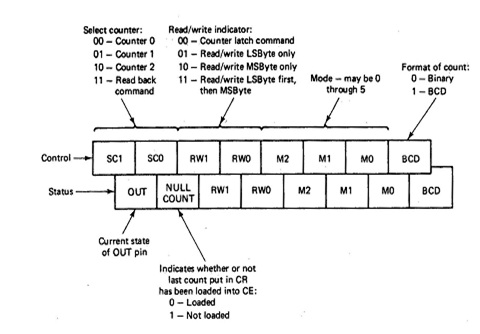
Modes of 8254 :


1632_modes of 8254.jpg

Mode 0 (Interrupt on Terminal Count)-GATE which value is 1 enables counting and GATE  which value is 0 disables counting, and GATE put not effect on OUT. The contents of the CR are transferred to CE on the first CLK pulse after CR is written into by the processor, unrelated of the signal on the GATE pin. Pulse that loads CE is not included in the count. OUT would low when there is an output to the control register and remains low till the count goes to 0.Primarily, Mode 0 is for event counting.

Mode 1 (Hardware Re -triggerabic  One-Shot)-After  CR has been loaded  with N, a 0-to-1  transition  on GATE will cause CE to be loaded, a one-to-zero transition  at OUT, and the count to start. When the count reaches to zero OUT will go high so producing a negative-going OUT pulse N clock periods long.

Mode 2 (Periodic Interval Timer)-after loading CR with N, a transfer is occur from CR to CE on the next clock pulse. OUT goes from one  to zero when the count becomes one and remains low for o1 CLK pulse; then it returns to 1 and CE is reloaded from CR, so  giving a negative pulse at OUT after each N clock cycles. GATE that value 1 enables the count and GAT that value is 0 disables the count. A 0-to-1 transition on GATE also causes the count to be reinitialized on the next clock pulse. This mode is utilized to provide a programmable periodic interval timer.

Mode 3 (Square-Wave Generator)-It is likewise to mode 2 except that OUT goes low when half the first count is reached and remains low till the count becomes zero. So the duty cycle is changed. As like before, GATE enables and disables the count and a zero to one transition on GATE reinitializes the count. This mode can be utilized for baud rate generation.

Mode 4 (Software-Triggered  Strobe)-It is likewise to mode 0 except that OUT is high while the counting is taking place and generate a one-clock-period negative pulse when the count reaches zero.

Mode 5 (Hardware-Triggered Strobe-Retriggerabic)-After CR is loaded, a O-to-I transition on GATE will cause a transfer from CR to CE during the next CLK pulse. OUT will be high in the time counting but will go low for one CLK period when the count becomes zero. GATE may reinitialize counting at any time.

For all modes, if the starting count is zero, it will be interpreted as216 or104 depending on the format of the count. The above descriptions were just to provide a whole idea of the operation of the 8254 in the several modes.


Related Discussions:- Modes of 8254-microprocessor

Input output memory mapped-microprocessor, Memory Mapped I/O Memory I/O...

Memory Mapped I/O Memory I/O devices are mapped into the system memory map with ROM and RAM. To access a hardware  device, simply write or  read  to  those  'special'  addresse

Assignment, Write an assembly program that adds the elements in the odd ind...

Write an assembly program that adds the elements in the odd indices of the following array. Use LOOP. What is the final value in the register?

Relocate program and data, ) What is the difference between re-locatable pr...

) What is the difference between re-locatable program and re-locatable data?

Rcr-rcl-logic instruction-microprocessor, RCR: Rotate Right through Carry:...

RCR: Rotate Right through Carry:- This instruction rotates the contents  bit-wise of the destination operand right by the specified count through carry flag (CF). For each operati

Implement an assembly language program, A good starting point for your prog...

A good starting point for your program is the toupper.asm program shown in class. It already queries the user for input and sets up a loop that looks at each character of the input

First generation microprocessor, 1 st Generation Microprocessor : At ...

1 st Generation Microprocessor : At the end of the 70s a group of engineers developed a chip is able to processing data. This chip was called processor chip. Big processors w

Instructions, Difference between div and idiv

Difference between div and idiv

Assembly language assignment, The main objective of the assignment is to ex...

The main objective of the assignment is to explore the knowledge regarding parallel ports of a computer system. You can read and write datato/from the parallel port using IN and OU

Aas-arithmetic instruction-microprocessor, AAS: ASCII Adjust AL After Subt...

AAS: ASCII Adjust AL After Subtraction AAS instruction correct the result in the AL register after subtracting operation of two unpacked ASCII operands. The result is in unpacked

8237 modes-microprocessor, 8237 modes : Intel 8237 can be set to four d...

8237 modes : Intel 8237 can be set to four different type of style of transfer: 1) Single - One transfer at a time,  it allow processor access to the bus between transfers

Write Your Message!

Captcha
Free Assignment Quote

Assured A++ Grade

Get guaranteed satisfaction & time on delivery in every assignment order you paid with us! We ensure premium quality solution document along with free turntin report!

All rights reserved! Copyrights ©2019-2020 ExpertsMind IT Educational Pvt Ltd