Maximum stress in each material, Mechanical Engineering

Assignment Help:

The maximum stress in each material:

A copper tube of external diameter 60 mm and internal diameter 40 mm is closely fitted to a steel rod of 40 mm diameter to compose a composite shaft. If a torque of 6 kN-m is to be resisted by the shaft, discover the maximum stress in each material and the angle of twist in 2 m length.

Take  G = 80 kN/mm for steel, and

G = 40 kN/mm2 for copper.

Solution

Copper Tube

G = 40 kN/mm2  = 0.4 × 10¹¹ N/m2 , l = 2 m

d1 = 60 mm = 0.06 m

d2 = 40 mm = 0.04 m

2451_Maximum stress in each material.png

TC = torque resisted by copper tube

θ= Tl/ GJ    =  (TC ) (2) /((0.4 × 1011 ) (1 × 10- 6 )) = 2 TC × 10- 5 radians       ---------- (1)

τmax =  (T/J )× R = (1 × 10- 6 ) × (0.03) = 0.03 TC  × 10  N/m

         = 0.03 TC N/mm2                             ------------ (2)
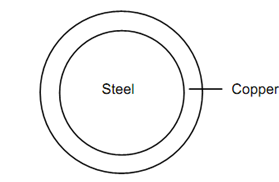
1689_Maximum stress in each material1.png

Figure

G = 80 kN/mm2  = 0.8 × 10¹¹ N/m2 ,   l = 2 m

d = 40 mm

J =  (π/32) d 4 = (π /32)× 0.044  = 2.5 × 10- 7 m4

R = 20 mm = 0.02 m

θ= Tl  / GJ  = (TS ) (2) / ((0.8 × 10¹¹ ) (2.5 × 10- 7 )) = TS × 10- 4 radians  --------- (3)

τmax =(T/ J) × R =  Ts / ((2.5 × 10- 7 ) (0.02)) = 0.008 TS  × 107  N/m

= 0.08 TS N/mm2                                    --------- (4)

In composite shafts, θC = θS

 ⇒        5 TC  × 10- 5  = TS  × 10- 4

∴          TC  = 2TS                                  -------- (5)

TS  + TC  = T

⇒         TS = 2TS  = 6

∴          TS = 2 kN-m             TC  = 4 kN-m

∴ Angle of twist, θ= (2 × 10³ ) × 10- 4  = 0.2 radians

Maximum Shear Stress

For copper shaft : For steel shaft :

τmax  = 0.03 × 4 × 103  = 120 N/m2

τmax  = 0.08 × 2 × 103  = 160 N/m2


Related Discussions:- Maximum stress in each material

Explain sulphidation process, Q. Explain Sulphidation process? The pres...

Q. Explain Sulphidation process? The presence of sulphur converts the surface of the metal to a sulphide scale which is generally more destructive than an oxide scale. Sulphid

Branches of mechanics, Branches of mechanics: Mechanics is basically d...

Branches of mechanics: Mechanics is basically divided in to two parts Static's and Dynamics, Dynamics is further divided in kinematics and kinetics Statics: It deals with

Drainage of the railway track - construction of railway line, Drainage of t...

Drainage of the Railway Track: It is necessary to keep the embankment free from water. This is done by providing side ditches, all along the edge of the embankment, and leadi

Determine magnitude of the couple, Determine magnitude of the couple: ...

Determine magnitude of the couple: A square block having each side 1.5 m is acted upon by system of forces along its sides as shown in the adjoining figure. If system reduces

Dead centre -engine terminology , Dead Centre The position of the wor...

Dead Centre The position of the working piston and the moving parts which are mechanically connected to it, at the moment when the direction of the piston motion is reserved

Measurement of hardenability, Measurement of Hardenability: Two testi...

Measurement of Hardenability: Two testing techniques have been enhancement to measure the harden-ability of steels. The first, termed as cylinder series test, offers a single

Describe about chain-wire and tape gauges, Q. Describe about Chain-wire and...

Q. Describe about Chain-wire and tape gauges? Chain, wire and tape gauges are fixed on structures like bridges and the weight is lowered to touch the water surface. Movable sti

Alignment of a railway line - railways, Alignment of a Railway Line: ...

Alignment of a Railway Line: Selection of Alignment The following points must be considered in selecting the alignment of a railway line : (a) It should be as direct

Write Your Message!

Captcha
Free Assignment Quote

Assured A++ Grade

Get guaranteed satisfaction & time on delivery in every assignment order you paid with us! We ensure premium quality solution document along with free turntin report!

All rights reserved! Copyrights ©2019-2020 ExpertsMind IT Educational Pvt Ltd