Liquid crystal display (lcd):
Liquid Crystal Displays (LCD) are not actually light sources - they generate no light, merely filtering incident light, in a controlled manner. The LCDs seen in watches, clocks and calculators etc, all work by the same principle.
Two transparent but conductive plates sandwich a layer of liquid crystals, which normally all face in the same direction. See Figure 9. Incident light passes through the liquid crystals of polarised particles fairly easily, and is reflected back through the crystals so that an observer sees a light coloured area.
However, a voltage applied across the plates causes the liquid crystals to change direction in an attempt to repolarise themselves with the applied voltage. As they turn, they interact with the current flowing between the plates and a state of turbulence is created. The moving particles scatter the incident light, randomly reflecting and refracting it. Little light is reflected back to the observer, so the area between the transparent plates appears dark.
Selection of the areas, which are turned dark by using a number of plates and different shaped plates, means that practically any shape of character may be displayed.
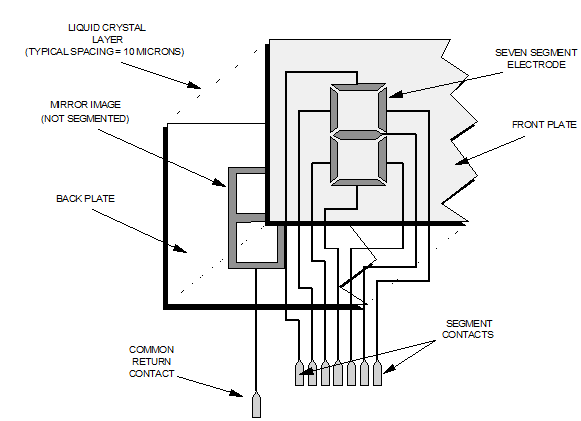
The space between the plates is filled with a liquid crystal compound, and the complete assembly is hermetically sealed with a special thermoplastic material to prevent contamination.
When a low-voltage, low-current signal is applied to the segments, the polarisation of the compound is changed together with a change in its optical appearance from transparent to reflective. The magnitude of the optical change is basically a measure of the light reflected from, or transmitted through, the segment area to the light reflected from the background area. Thus, unlike a LED, it does not emit light, but merely acts on light passing through it. Depending on the polarisation film orientation, and whether the display is reflective or transmissive, the segment may appear dark on a light background (such as in digital watches and pocket calculators) or light on a dark background.