Illustration of image processing, MATLAB in Engineering

Assignment Help:

Illustration of Image processing:

This displays that there are 64 rows, or in another word, 64 colors, in this specific colormap. It also displays that the first five colors are shades of blue.

The format of calling the image function is as shown below:

image(mat)

here the matrix mat is a matrix which represents the colors in an m × n image. When the matrix has the size m × n, then each and every element is an index into the present colormap.

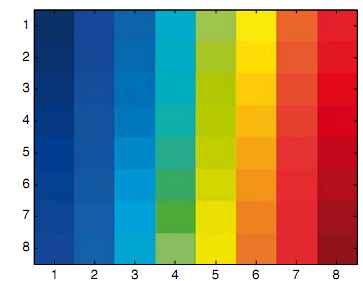
The one way to show the colors in the jet colormap (that has 64 colors) is to generate a matrix which stores the values 1 through 64, and pass that to the image function, as shown in figure.
2081_Illustration of Image processing.png

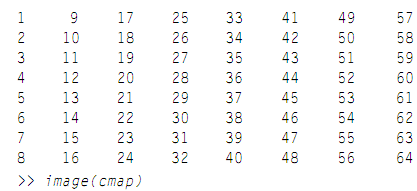
Whenever the matrix is passed to the image function, then the value in each element in matrix is used as an index into the colormap. For illustration, the value in cmap(1,2) is 9, therefore the color displayed in position(1,2) in the image will be the color presented by the ninth row in the colormap. By using numbers 1 through 64, we can see all colors in this colormap.

>> cmap = reshape(1:64, 8,8)

cmap =
1687_Illustration of Image processing1.png


This represents that the first colors are shades of blue, the end colors are shades of red, and in between there are shades of aqua, green, yellow, & orange.


Related Discussions:- Illustration of image processing

Illustration of matrix solutions, Illustration of Matrix solutions: Fo...

Illustration of Matrix solutions: For illustration, consider the three equations below with 3unknowns x 1 ,x 2 , and x 3 : We can write this in the form Ax = b here A

Illustration of subfunctions, Illustration of Subfunctions: This is an...

Illustration of Subfunctions: This is an illustration of running this program: >> rectarea Please enter the length: 6 Please enter the width: 3 For a rectan

Expanding a function, Expanding a function: The expand function will m...

Expanding a function: The expand function will multiply out terms, and factor will do the opposite: >> expand((x+2)*(x-1)) ans = x^2 x-2 >> factor(ans)

Illustration of passing arguments to functions, Illustration of Passing arg...

Illustration of Passing arguments to functions: Here is an illustration of calling this function: >> printrand() The random # is 0.94 As nothing is passed to

Function iscellstr - string, Function iscellstr - string function: The...

Function iscellstr - string function: The function iscellstr will return the logical true when a cell array is a cell array of all the strings, or logical false if not. >>

Readlenwid function - subfunctions, readlenwid function: function cal...

readlenwid function: function call: [length, width] = readlenwid; function header: function [l,w] = readlenwid In the function call, not any argument is passed; henc

Illustration of symbolic variable, Illustration of symbolic variable: ...

Illustration of symbolic variable: When, on the other hand, z is a symbolic variable to start with, quotes are not required around the expression, and the words are automatica

Example to change the line width from the default, Example to change the li...

Example to change the line width from the default: For illustration, to change the line width from the default of 0.5 to 1.5: >> set(hl,'LineWidth',1.5) As long as the

Variable scope, Variable Scope: The scope of any of variable is the wo...

Variable Scope: The scope of any of variable is the workspace in which it is valid. The workspace generated in the Command Window is known as the base workspace. As we know

Displaying the cell arrays, Displaying the cell arrays: There are seve...

Displaying the cell arrays: There are several techniques of displaying the cell arrays. The celldisp function shows all elements of the cell array:   >> celldisp(cellro

Write Your Message!

Captcha
Free Assignment Quote

Assured A++ Grade

Get guaranteed satisfaction & time on delivery in every assignment order you paid with us! We ensure premium quality solution document along with free turntin report!

All rights reserved! Copyrights ©2019-2020 ExpertsMind IT Educational Pvt Ltd