How do you traverse a binary tree, Mathematics

Assignment Help:

How do you traverse a Binary Tree?  Describe Preorder, Inorder and Postorder traversals with example.    

Ans: Traversal of tree means tree searching for a aim. The aim may be for searching or sorting of the items consisted of in a tree. A tree may consist of an item at its node as a label.

Traversing a tree is a recursive process. 
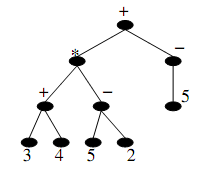
1764_How do you traverse a Binary Tree.png

To apply this, a tree is considered to comprise three components: root, left subtree and right subtree. These three components can be in order in six different ways: (left, root, right), (root, left, right), (left, right, root), (right, left, root), (right, root, left) and (root, right, left). The first three are used while the last three combinations are of no make use of as it alters the positions of a node in a positional tree.

Inorder Traversal: In this type of traversal, a tree is traversed in the sequence: Left subtree, Root, Right subtree.   

In the above expression, start at the root node marked, +. As first we have to traverse its left subtree, thus move to the root of left subtree that is node marked, *. Once again it has a left subtree with root node marked +, visit it. This subtree has a node labeled 3 that has no left subtree, thus out put 3. Then root of this subtree that is '+' and then right subtree which is once again a node labeled with 4, so output it. So we have expression acquired till here is 3 + 4.

Proceeding this way we acquire (3+4)*(5-2) + (-5). Parentheses signify both precedence and portion of the sub tree to which this sub-expression corresponds.     

Preorder Traversal: In this type of traversal a tree is traversed in the sequence: Root, Left subtree, Right subtree. Apply the algorithm recursively till all nodes have been visited, we acquire + * + 3 4 - 5 2 -5. 

Postorder Traversal: In this type of traversal a tree is traversed in the sequence: Left subtree, Right subtree, Root. We acquire 3 4 + 5 2 - * 5 - +.


Related Discussions:- How do you traverse a binary tree

Parallel and perpendicular lines, The last topic that we have to discuss in...

The last topic that we have to discuss in this section is that of parallel & perpendicular lines. Following is a sketch of parallel and perpendicular lines. Suppose that th

Derivative with polar coordinates - parametric equations, Derivative with P...

Derivative with Polar Coordinates dy/dx = (dr/dθ (sin θ) + r cos θ) / (dr/dθ (cosθ) - r sinθ) Note: Rather than trying to keep in mind this formula it would possibly be easi

Arc length and surface area revisited, Arc Length and Surface Area Revisite...

Arc Length and Surface Area Revisited We won't be working any instances in this part.  This section is here exclusively for the aim of summarizing up all the arc length and su

Linear graph, in the form of linear graph interpret the ralationship betwee...

in the form of linear graph interpret the ralationship between two quantities

Probability, The probability that a leap year will have 53 sunday is ? and ...

The probability that a leap year will have 53 sunday is ? and how please explain it ? (a)1/7    (b) 2/7    (c) 5/7    (d)6/7 Sol) A leap year has 366 days, therefore 52 weeks i.e

Area between curves, Area between Curves In this section we will be fi...

Area between Curves In this section we will be finding the area between two curves. There are in fact two cases that we are going to be looking at. In the first case we des

Prime number, Prime number A prime number is a number whose only +ve fa...

Prime number A prime number is a number whose only +ve factors are 1 and itself. For instance 2, 3, 5, and 7 are all of the examples of prime numbers.  Examples of numbers whic

Write Your Message!

Captcha
Free Assignment Quote

Assured A++ Grade

Get guaranteed satisfaction & time on delivery in every assignment order you paid with us! We ensure premium quality solution document along with free turntin report!

All rights reserved! Copyrights ©2019-2020 ExpertsMind IT Educational Pvt Ltd