Graph for the sequence - sequences and series, Mathematics

Assignment Help:

Graph for the Sequence

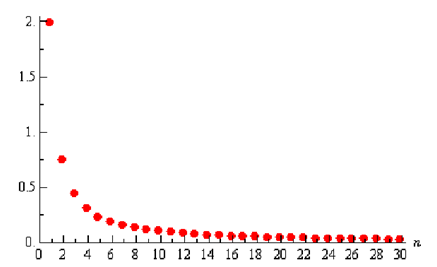
First we wish to think about the term graphing a sequence. To graph the sequence {an} we plot the points {n, an} as n ranges over every possible values on a graph. For example, let's graph the sequence {n+1 / n2} n =1. The 1st few important points on the graph are,

 (1,2) , (2, ¾ ) , (3, 4/9) , (4, 5/16) , (5, 6/25), ....

After that the graph, for the first 30 terms of the sequence is as follow:
644_Graph for the Sequence - Sequences and Series 1.png

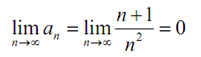
This graph leads us to a major idea regarding to the sequences.  Note: As n increases the sequence terms in our sequence, in this example, get closer and closer to zero.  After that we say that zero is the limit (or sometimes the limiting value) of the sequence and write,
1488_Graph for the Sequence - Sequences and Series 2.png

This note should look well known to you.  It is similar notation we used while we talked about the limit of a function.  Actually, if you remind, we said previous that we could think of sequences as functions in some way and thus this notation shouldn't be also surprising.


Related Discussions:- Graph for the sequence - sequences and series

Pair of st line, #qu Given the equation through what angle should the axes...

#qu Given the equation through what angle should the axes be rotated so that the term in xy be waiting from the transformed equation. estion..

Outer automorphism, (a) An unordered pair fm; ng with 1 ≤ m ≠ n ≤ 6 is ca...

(a) An unordered pair fm; ng with 1 ≤ m ≠ n ≤ 6 is called a duad. List the 15 duads. (b) There are 15 ways to partition {1, ......, 6 } into 3 duads, such as { {1; 2}, {3, 4},

Introduction to knowing your maths learner, INTRODUCTION : The other day I...

INTRODUCTION : The other day I overheard 6-year-old Ahmed explaining to his older sister about why swallowing the seeds of an orange is harmful. He said, "The seed will become a p

Chain rule, Chain Rule :   If f(x) and g(x) are both differentiable func...

Chain Rule :   If f(x) and g(x) are both differentiable functions and we describe F(x) = (f. g)(x) so the derivative of F(x) is F′(x) = f ′(g(x)) g′(x).  Proof We will s

Function, definition and examples and types

definition and examples and types

Demerits and merits -the arithmetic mean or a.m, Demerits and merits of the...

Demerits and merits of the measures of central tendency The arithmetic mean or a.m Merits i.  It employs all the observations given ii. This is a very useful

Determine the average bit rate - huffman codebook, 1. Consider a source wi...

1. Consider a source with 4 symbols {a,b,c,d}. The probability of the 4 symbols are P(a)=0.4, p(b) = 0.1, p(c)=0.2, p(d)= 0.3. a. Design a Huffman codebook for these symbols.

Determine the probability of tossing a head, Q. Determine the probability o...

Q. Determine the probability of tossing a head? Let B represent the event of tossing a heads with the nickel in example 2. Find P(B). Solution:   S = {(H, H), (H, T), (T, H

Write Your Message!

Captcha
Free Assignment Quote

Assured A++ Grade

Get guaranteed satisfaction & time on delivery in every assignment order you paid with us! We ensure premium quality solution document along with free turntin report!

All rights reserved! Copyrights ©2019-2020 ExpertsMind IT Educational Pvt Ltd