Find the solution to initial value problem, Mathematics

Assignment Help:

Illustration:  Find the solution to the subsequent IVP.

ty' + 2y = t2 - t + 1,      y(1) = ½

Solution:

Initially divide via the t to find the differential equation in the accurate form.

y' + (2/t) Y = t - 1 + 1/t

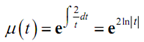
Currently let's find the integrating factor, µ(t):
753_Find the solution to initial value problem.png

Currently, we require to simplify µ(t). Although, we can't utilize (11) as which needs a coefficient of one in front of the logarithm.  Thus, recall as

In xr = r In x

And rewrite the integrating factor in a form which will permit us to simplify this.

µ(t) = e 2In|t| = eIn|t|2 = |t|2 = t2

We were capable to drop the absolute value bars here as we were squaring the t, but frequently they can't be dropped therefore be careful along with them and don't drop them unless you identify that you can. Frequently the absolute value bars must continue

Here, multiply the rewritten differential equation but remember that we can't utilize the original differential equation here, through the integrating factor.

(t2y)' = t3 - t2 + t

Integrate both sides and resolve for the solution.

t2y = ∫t3 - t2 + t dt

= ¼t4 - ? t3 + t dt

 y(t) = ¼t2 - ? t3+ ½ + c/t2

At last, apply the initial condition to find the value of c.

½ = y(1) = ¼ - 1/3 + ½ + c ⇒ c= 1/12

The solution is afterward,

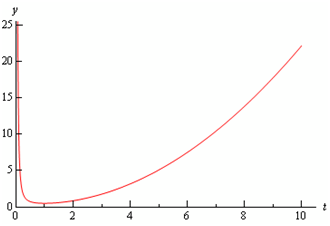
y(t) = ¼t2 - ? t3+ ½ + 1/12t2

Now is a plot of the solution.
1061_Find the solution to initial value problem1.png


Related Discussions:- Find the solution to initial value problem

Chain rule, Chain Rule :   If f(x) and g(x) are both differentiable func...

Chain Rule :   If f(x) and g(x) are both differentiable functions and we describe F(x) = (f. g)(x) so the derivative of F(x) is F′(x) = f ′(g(x)) g′(x).  Proof We will s

Capture a curvature in the relationship - quadratic model, 1. Consider the ...

1. Consider the model Y t = β 0 + β 1 X t + ε t , where t = 1,..., n.  If the errors ε t are not correlated, then the OLS estimates of  β 0   and β

Mean value theorem function, Mean Value Theorem : Suppose f (x) is a funct...

Mean Value Theorem : Suppose f (x) is a function which satisfies both of the following. 1. f ( x )is continuous on the closed interval [a,b]. 2. f ( x ) is differentiable on

Probability, joey asked 30 randomly selected students if they drank milk, j...

joey asked 30 randomly selected students if they drank milk, juice, or bottled water with their lunch. He found that 9 drank milk, 16 drank juice, and 5 drank bottled water. If the

Binding constraints for the original linear program model, A toy company pr...

A toy company produces 2 models of water guns: spray king and zapper. They are manufactured in batches for easier packaging and sale. Two of the limiting resources are 1200 pounds

Problem Solving, Max can paint a house in 3 hours. Saria can paint a house...

Max can paint a house in 3 hours. Saria can paint a house in 5 hours. working together, how long will it take both Saria and Max to paint a house?

Find out the surface area of the solid, Find out the surface area of the so...

Find out the surface area of the solid acquired by rotating y = √ (9-x 2 ), - 2 x 2 about the x-axis. Solution The formula that we'll be using here is, S = ∫ 2Πyds

Find the value of the derivative, Given y = f(x) = x 2 + 2x +3 a) Use the ...

Given y = f(x) = x 2 + 2x +3 a) Use the definitional formula given below to find the derivative of the function. b) Find the value of the derivative at x = 3.

Write Your Message!

Captcha
Free Assignment Quote

Assured A++ Grade

Get guaranteed satisfaction & time on delivery in every assignment order you paid with us! We ensure premium quality solution document along with free turntin report!

All rights reserved! Copyrights ©2019-2020 ExpertsMind IT Educational Pvt Ltd