Explain medium length lines, Electrical Engineering

Assignment Help:

Explain Medium length lines?

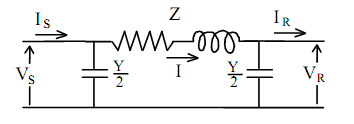
Medium length lines cover lines in the range of 50 to 150 miles (80 to 240 km). Due to the increased length of the line, the shunt capacitance of the line is significant and is included in the equivalent circuit model. Therefore, the line model may be represented by a π network, as shown in Figure.
1087_Explain Medium length lines.png

Using Kirchhoff's voltage and current laws, the π circuit gives:

VS = VR + Z I         (1)

I = IR + Y/2 VR      (2)

IS = I + Y/2 VS      (3)

To obtain VS and IS in terms of VR and IR , substitute equation (2) into (1) which gives:

VS = [(1 + ZY) / 2] VR + Z IR                                                    (4)

Substituting equations (4) and (2) into equation (3) and rearranging yields:

IS = [(1 + ZY) / 4] Y VR + [(1 + ZY) / 2] IR        (5)

Comparing equations (4) and (5) with equations gives the 2-port network constants as:

A = [(1 + ZY) / 2], B = Z

C = [(1 + ZY) / 4], D = [(1 + ZY) / 2] = A

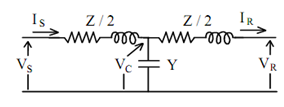
Another way of representing a medium length line is by the Τ network shown in Figure. In this case:

VS = VC + Z/2 IS                                              (6)

VC = VR + Z/2 IR   and                          (7)

IS = IR + Y VC                                                   (8)
1583_Explain Medium length lines 2.png

As for the π network, equations (6-8) may be solved and rearranged to obtain VS and IS in terms of VR and IR as:

VS = [(1 + ZY) / 2] VR + [(1 + ZY) / 4] IR                                           (9)

IS = Y VR + [(1 + ZY) / 2] IR                                                                     (10)

This gives the 2-port network constants as:

A = [(1 + ZY) / 2], B = [(1 + ZY) / 4] Z

C = Y, D = [(1 + ZY) / 2] = A


Related Discussions:- Explain medium length lines

Neutral line in transformer, thus secondary winding of transformer consists...

thus secondary winding of transformer consists of neutral line or not?

Explain state transition diagram, a. Explain State Transition Diagram and d...

a. Explain State Transition Diagram and define the various SDL symbols used in state transition diagram. b. Draw the signal exchange diagram for a local call used to show the se

Power, why do we use commutator?

why do we use commutator?

Fundamental of metal casting, Fundamental of Metal Casting: Fundament...

Fundamental of Metal Casting: Fundamental of Metal Casting : Casting process is based on the property of a liquid to take up the shape of vessel containing it. Molten metal

Constant frequency system, Constant Frequency System In this  system c...

Constant Frequency System In this  system chopping period  T is kept constant but the  on time T om is varied. This  system is also referred to pulse with modulation or time

Define the term real time clock, Define the term real time clock. A re...

Define the term real time clock. A real-time clock maintains the time in real time, which is, in hours and minutes. For the real-time clock the software contains an interrupt

Explain thermoplastic materials, Explain Thermoplastic materials. Ther...

Explain Thermoplastic materials. Thermoplastic materials: The properties of such plastic materials do not change considerably when they are melted and after that cooled and s

Relationship between the induced e.m.f and the network, Mathematical relati...

Mathematical relationship between the induced e.m.f and the network Faraday noted that the e.m.f induced in a loop is proportional to the rate of change of magnetic flux by it:

On which hysteresis loss is least depend, Hysteresis loss least depends on ...

Hysteresis loss least depends on (A) Frequency.                         (B) Magnetic field intensity. (C) Volume of the material.     (D)Grain orientation of material.

Write Your Message!

Captcha
Free Assignment Quote

Assured A++ Grade

Get guaranteed satisfaction & time on delivery in every assignment order you paid with us! We ensure premium quality solution document along with free turntin report!

All rights reserved! Copyrights ©2019-2020 ExpertsMind IT Educational Pvt Ltd