Explain hyper cube interconnection networks, Computer Networking

Assignment Help:

Hyper Cube: A Hypercube interconnection network is an expansion of cube network. For n=3, Hypercube interconnection network may be described recursively in this manner: 

For n = 3, it cube network in that nodes are allocated number 0, 1, ......,7 in binary. In different way, one of the nodes is allocated a label 000, another one as 001.... and the final node as 111. Then whichever node can communicate with another node if their labels vary in accurately one place, for example the node with label 101 can communicate straight with 001, 000 and 111.

For n > 3, a hypercube may be described recursively in this manner:

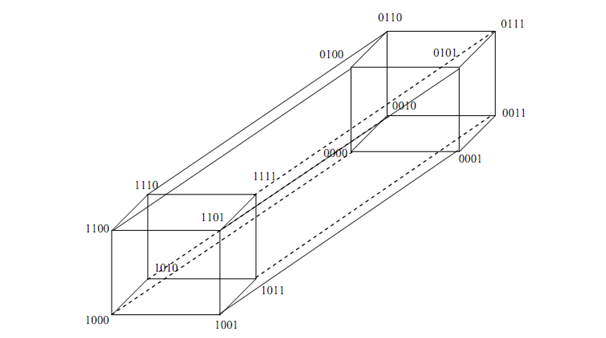
Take two hyper cubes of dimension (n - 1) every having (n -1) bits labels as 00....0, ......11.....1 

Next link the two nodes having similar labels each (n - 1) dimension hypercubes and link these nodes. Next prefix "1" the labels of one of the (n - 1) dimensional hypercube and "0" to labels of other hypercube. This entirely completes the structure of n-dimensional hypercube. Straight/Direct connection is just between that pair of nodes that has a (solid) line associating the two nodes in pair.

For n = 4 we draw 4-dimensional hypercube as displayed in Figure:
 

1949_Explain Hyper Cube Interconnection Networks.png


Figure: 4-Dimensional hypercube


Related Discussions:- Explain hyper cube interconnection networks

What are main types of networks and explain, a)  Peer-to-Peer Network Co...

a)  Peer-to-Peer Network Computers can act as both servers sharing resources and as clients using the resources. b)  Server-based Network Give centralized control of netwo

Data mining, The following DNA sequences are extracted from promoter region...

The following DNA sequences are extracted from promoter region of genes which are co-regulated by the same transcription factor (TF). The nucleotide segments capitalized in the giv

How many cycles are lost for instruction accessing memory, 1.  A computer s...

1.  A computer system has a two-level memory cache hierarchy. The L1 cache has a zero hit penalty, a miss penalty of 5 ns and a hit rate of 95 percent. The L2 cache has a miss pena

Diffrence between network vs internet layers, Q. Diffrence between Network ...

Q. Diffrence between Network vs Internet Layers? - Similar to all the other OSI Layers the network layer provides both connectionless and connection-oriented services. From th

Explain typical network topologies, Question: a) Explain briefly three ...

Question: a) Explain briefly three typical network topologies giving one advantage and one disadvantage of each topology. Explain the three topologies with appropriate diagrams

Describe the method of one way redistribution and mutual, Define  the conce...

Define  the concept of one way redistribution and mutual

Typical functional units of the client/server applications, What are the mo...

What are the most typical functional units of the Client/Server applications? Ans) typical functional units of the Client/Server applications User interface Business Logic

Compute the number of lost packets of the down-stream, A mobile host (MH) i...

A mobile host (MH) is connected to a WLAN access network that uses MIP for mobility support. Consider that the RTTs between MH and HA are 0.3s while RTTs within a L2 subnet are 80

Write the definition of SAN, Write the definition of SAN A SAN is a sep...

Write the definition of SAN A SAN is a separate network to handle storage requirements. The SAN detaches storage tasks from specific servers and makes a shared storage facility

Write Your Message!

Captcha
Free Assignment Quote

Assured A++ Grade

Get guaranteed satisfaction & time on delivery in every assignment order you paid with us! We ensure premium quality solution document along with free turntin report!

All rights reserved! Copyrights ©2019-2020 ExpertsMind IT Educational Pvt Ltd