Explain economic order quantity, Financial Management

Assignment Help:

Q. Explain Economic Order Quantity?

Economic Order Quantity (EOQ):- Economic order quantity (EOQ) is that quantity of material for which each order must be placed. Purchasing large quantities at one time as well as keeping the same as stock and increases carrying cost of inventories but reducing ordering cost of inventories. Alternatively small orders reduce the average inventory level thereby reducing the carrying cost of inventories however increasing the ordering costs because of increased number of purchase orders. Thus determination of economic order quantity is a trade-off between two types of inventory costs:

(i) Ordering costs: - Ordering costs comprises costs of placing orders as well as cost of receiving delivery of goods such as clerical expenses in preparing a receiving expenses, purchase order, transportation expenses, inspection expenses and recording expenses of goods received.

(ii) Carrying Cost: - Carrying cost comprises costs of maintaining or carrying inventory such as insurance expenses, godown rent etc. These costs vary with inventory size.

The sum of ordering costs as well as carrying costs represents the total costs of inventory. Economic order quantity is that order quantity at which the total of ordering as well as carrying cost is minimum. Economic order quantity is able to be explained with the help of following diagram:
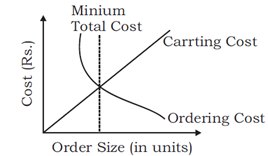
606_Explain Economic Order Quantity.png

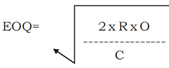
Formula: - EOQ can be resolved by the following formula:
759_Explain Economic Order Quantity1.png

EOQ = Economic Order Quantity

R = Annual purchase Requirements in units

O = Ordering cost per order

C = Carrying cot per unit.


Related Discussions:- Explain economic order quantity

What is emerging issues task force, Q. What is Emerging Issues Task Force? ...

Q. What is Emerging Issues Task Force? Emerging Issues Task Force (EITF) - Assists FINANCIAL ACCOUNTING STANDARDS BOARD (FASB) and provides guidance on early identification of

What is profit maximisation criterion, Profit maximisation criterion P...

Profit maximisation criterion Profit maximisation criterion is unsuitable and inappropriate as an operational objective of financing, investment and dividend decisions of a fi

What was the second ground of criticism, What was the Second ground of crit...

What was the Second ground of criticism of traditional treatment Second ground of criticism of the traditional treatment was that focus was on financing problems of corporate e

Analyse the corporate governance issues facing x company, M has recently jo...

M has recently joined the board of X Company, a main listed confectionary manufacturer. The company was established as a family business over a century ago and members of the found

Principle of opportunity cost, Suppose you have recently been contracted as...

Suppose you have recently been contracted as a financial consultant to a London-based engineering company, Alpha Products Plc. The company uses three components as part of their pr

Cost of capital, Dividends are expected to grow at a constant rate of 5 per...

Dividends are expected to grow at a constant rate of 5 percent per year in the future. Firms last dividend was $1 and stock price 10 dollars the firms beta 1,2 the rate of return o

Expected value application in finance - project evaluation, Project Evaluat...

Project Evaluation The expected value calculations are crucial to project investment decisions. The following example explains the use of probabilities in project evaluation.

Define required cash and surplus cash, 1. What is a venture's present value...

1. What is a venture's present value? Does the past matter? What is meant by the statement, "If you are not using estimates, you are not doing a valuation?" 2. Define (a) requ

Define the meaning of earn out arrangements, Earn out arrangements   C...

Earn out arrangements   Consideration could be delayed and paid only upon achievement of certain criteria. For illustration the predator company may pay additional cash if acq

How to calculate cost of capital?, To calculate the Cost of Capital, we wil...

To calculate the Cost of Capital, we will use the Weighted Average Cost of Capital (WACC) formula             WACC = (E/V) X R E + (D/V) X R D X (1 - T C ) where

Write Your Message!

Captcha
Free Assignment Quote

Assured A++ Grade

Get guaranteed satisfaction & time on delivery in every assignment order you paid with us! We ensure premium quality solution document along with free turntin report!

All rights reserved! Copyrights ©2019-2020 ExpertsMind IT Educational Pvt Ltd