Explain coronary anatomy, Biology

Assignment Help:

Q. Explain Coronary Anatomy?

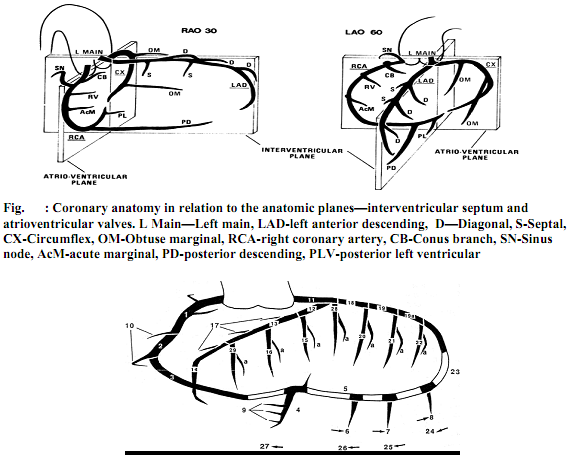
The main coronary trunks can be considered to lie in one of two orthogonal planes. The anterior descending and the posterior descending coronary arteries lie in the plane of the interventricular septum, whereas the right and left circumflex trunks lie in the plane of the atrioventricular valves.

Right Coronary Artery: 1: Proximal, 2: Middle, 3: Distal, 4: Posterior descending, 5: Posteroatrioventricular, 6: first posterolateral, 7: second posterolateral, 8: third posterolateral, 9: inferior septals, 10: acute marginals.

Left Coronary Artery: 11: Left Main, 12: Proximal left anterior descending, 13: Middle left anterior descending, 14: Distal left anterior descending, 15: first diagonal, 16: second diagonal, 17: septals, 18: Proximal circumflex, 19: Middle circumflex, 20: Distal circumflex, 21, 22, 23: first, second and third obtuse marginals, 23: left atrioventricular, 24, 25, 26: first, second and third posterolaterals, 27: left posterior descending, 28: Ramus intermedius, 29: Third diagonal.
1690_Coronary Anatomy.png


Related Discussions:- Explain coronary anatomy

Hormones secreted by parathyroid gland, Hormon e . The chief cells of the ...

Hormon e . The chief cells of the parathyroids secrete a hormone called parathyroid hormone (PTH) or parathormone or also called Collip's hormone after the name of its discove

Why is the development of bipedalism considered, Why is the development of ...

Why is the development of bipedalism considered to be a major advancement in human evolution?

Vitamin a requirements of school children and adolescents, Determine Vitami...

Determine Vitamin A requirements of school children and adolescents? The vitamin A requirement of children and adolescents has been computed from growth curve interpolation dat

Effect of genetic drift, Is the effect of genetic drift likely to be the sa...

Is the effect of genetic drift likely to be the same in pop 1 and pop 2? How are genetic drift and pop size related? when there is strong selection against the homozygous recessive

Explain the compound water, Explain the compound water? Water :  Wate...

Explain the compound water? Water :  Water is the most important compound in living cells, making up most of the bulk of living organisms. Our own bodies contain 40% - 60% wa

Fluoride - mineral elements, FLUORIDE It is mostly available in drin...

FLUORIDE It is mostly available in drinking water. Fluoride is essential for the formation of enamel of the teeth. Deficiency of fluoride causes weakness of enamel.

Production diseases, Pr o d u c t i o n Diseases The production...

Pr o d u c t i o n Diseases The production diseases, which were previously referred as metabolic diseases, include diseases like parturient paresis (milk fever), downer

Which chamber does the blood go after leaving left atrium, Q. To which hear...

Q. To which heart chamber does the blood go after leaving the left atrium? What is the valve that separates these compartments? The valve between the left atrium and the left v

What is a terrestrial organism, What is a terrestrial organism? 'Terra'...

What is a terrestrial organism? 'Terra' is the Latin word for earth. Thus, an animal that lives on the surface of the earth is known as terrestrial. This is the similar root wo

What is meant by binomial nomenclature, What is meant by binomial nomenclat...

What is meant by binomial nomenclature and what are its basic rules? Scientific nomenclature of a species must have, at least, two names: one that classifies it as genus and th

Write Your Message!

Captcha
Free Assignment Quote

Assured A++ Grade

Get guaranteed satisfaction & time on delivery in every assignment order you paid with us! We ensure premium quality solution document along with free turntin report!

All rights reserved! Copyrights ©2019-2020 ExpertsMind IT Educational Pvt Ltd