Explain call and return statements, Computer Engineering

Assignment Help:

Q. Explain Call and Return Statements?

CALL:

      CALL X    Procedure Call to procedure/function named X

  CALL instruction causes the following to happen: 

1.  Decrement the stack pointer so that we won't overwrite last thing put on stack

(SP <---SP - 1)
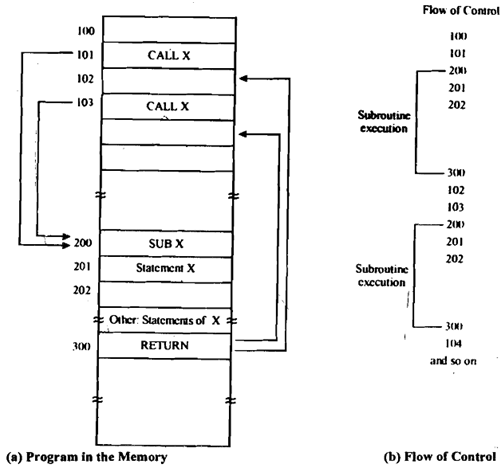
901_Call and Return Statements.png

Figure: Call and Return Statements

2.  The contents of PC that is pointing to NEXT instruction the one just after CALL is pushed onto stack and M [SP] <--- PC.

3.  JMP to X address of the start of subprogram is put in PC register.This is all a jump does. So we go off to the subprogram though we have to remember where we were in calling program which means that we should remember where we came from so that we can get back there again. 

PC <--- X 

RETN:

RETN      Return from procedure.   

RETN instruction causes following to happen: 

1.  Pops the stack to produce an address/label.If correctly used, the top of the stack will comprise the address of next instruction after the call from that we are returning; it's this instruction with that we want to resume in calling program.

2.  Jump to popped address it implies that put the address into PC register.

 PC <---  top of stack value; Increment SP.


Related Discussions:- Explain call and return statements

Application to calculate weekly payment of a company, Problem: A compa...

Problem: A company requires a software application to calculate the weekly payment for its employees. The information about the employees (employees' data) is kept in a file.

Networking, Nyquist''s sampling theorem says "if you have a signal that is ...

Nyquist''s sampling theorem says "if you have a signal that is perfectly band limited to a bandwidth of f0 then you can collect all the information there is in that signal by sampl

Simplify the expressions by using boolean postulates, Simplify the given ex...

Simplify the given expressions using Boolean postulates Y = (A + B)(A‾ + C)(B + C) Ans. Y = (A + B)(A‾ + C)(B + C) = (A A‾ + AC + B A‾ + BC) (B + C) = (AC + B A‾ + BC) (B + C)

C++, pebble merchant

pebble merchant

Differentiate between logical address and physical address, Differentiate b...

Differentiate between logical address and physical address. A logical address is the address of the data word or instruction as used by a program (it includes the use of base

Explain the term - integrity, Explain the term - Integrity In most c...

Explain the term - Integrity In most cases, corporate data should remain unchanged by third parties, so the system should be capable of ensuring that only authorised personn

Set screen and leave screen, What happens if only one of the commands SET S...

What happens if only one of the commands SET SCREEN and LEAVE SCREEN is used without using the other? If we use SET SCREEN without LEAVE SCREEN, the program ends processing for

How can we use / display table in a screen, How can we use / display table ...

How can we use / display table in a screen? ABAP/4 offers two mechanisms for showing and using table data in a screen.  These mechanisms are TABLE CONTROLS and STEP LOOPS.

Define seek time and latency time, Define seek time and latency time. ...

Define seek time and latency time.  The time taken by the head to move to the appropriate cylinder or track is known as seek time. Once the head is at right track, it must wai

Write Your Message!

Captcha
Free Assignment Quote

Assured A++ Grade

Get guaranteed satisfaction & time on delivery in every assignment order you paid with us! We ensure premium quality solution document along with free turntin report!

All rights reserved! Copyrights ©2019-2020 ExpertsMind IT Educational Pvt Ltd