Explain basic geometric concepts, Mathematics

Assignment Help:

Explain Basic Geometric Concepts ?

Points, lines, and planes are the most fundamental concepts in the study of geometry.

Points
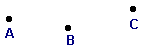
1281_Points.png

A point has no length, width or height; it indicates a position. A point is usually labeled by a capital letter and represented by a dot. We call the points below point A, point B and point C.

Line

929_Line.png

A line is straight and extends infinitely in two opposite directions. A line consists of an infinite number of points; it has no width and no height. The line below is called line a.

Planes
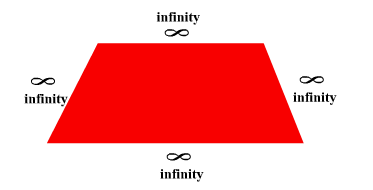
343_infinity.png

A plane is a flat (2-dimesional) surface, extending infinitely in all directions. A plane consists of an infinite number of points; it has infinite length and width, but no height. Think of a very large sheet of paper.

Spaces
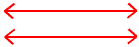
772_infinity1.png

A space is 3 dimensional. It has no boundaries; that is, it has an infinite number of points, and infinite length, width, and height. Think of a very big swimming pool.

Parallel lines
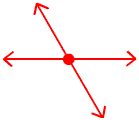
1470_Intersecting lines.png

Parallel lines are lines that never intersect. They are always the same distance apart. Think of never ending railroad tracks.

Intersecting lines
1660_Line segment.png

Intersecting lines are lines that share at least one point. Think of intersecting roads.

Segments

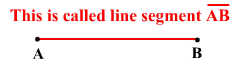
A segment is made up of two points and all the points between them. It is the same as a line with endpoints.

Rays
622_ray.png

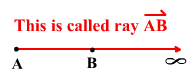
A ray is a part of a line. It begins at a point, called an endpoint, and then extends infinitely in one direction. Think of the ray of light from your flashlight.


Related Discussions:- Explain basic geometric concepts

Theorem of continuous functions, Consider the subsequent IVP. y' = f(t,y...

Consider the subsequent IVP. y' = f(t,y) ,        y(t 0 ) = y 0 If f(t,y) and ∂f/∂y are continuous functions in several rectangle a o - h o + h which is included in a

Taylor series, If f(x) is an infinitely differentiable function so the Tayl...

If f(x) is an infinitely differentiable function so the Taylor Series of f(x) about x=x 0 is, Recall that, f (0) (x) = f(x) f (n) (x) = nth derivative of f(x)

Mixing problems, Let's start things by searching for a mixing problem.  Pre...

Let's start things by searching for a mixing problem.  Previously we saw these were back in the first order section. In those problems we had a tank of liquid with several kinds of

The definition of the limit, The Definition of the Limit In this secti...

The Definition of the Limit In this section we will look at the precise, mathematical definition of three types of limits we'll be looking at the precise definition of limits

Value of the game-game theory, Value Of The Game The game value refers ...

Value Of The Game The game value refers to the average pay off per play of the game over an extended period of time

Differentiate y = x x using implicit differentiation, Differentiate y = x ...

Differentiate y = x x Solution : We've illustrated two functions similar to this at this point. d ( x n ) /dx = nx n -1                                 d (a x ) /dx= a

Who had the highest batting average, Mike, Dan, Ed, and Sy played together ...

Mike, Dan, Ed, and Sy played together on a baseball team. Mike's batting average was 0.349, Dan's was 0.2, Ed's was 0.35, and Sy's was 0.299. Who had the highest batting average?

Write Your Message!

Captcha
Free Assignment Quote

Assured A++ Grade

Get guaranteed satisfaction & time on delivery in every assignment order you paid with us! We ensure premium quality solution document along with free turntin report!

All rights reserved! Copyrights ©2019-2020 ExpertsMind IT Educational Pvt Ltd