Example of inflection point-differential equation, Mathematics

Assignment Help:

Example of inflection point

Determine the points of inflection on the curve of the function

y = x3

Solution

The only possible inflexion points will happen where

(d2y)/( dx2)   = 0

From specified function as:

(dy)/(dx) = 3x2 and (d2y)/( dx2)   = 6x

Equating the second derivative to zero, we include

 6x = 0 or x = 0

We test whether the point at that x = 0 is an inflexion point as follows

While x is slightly less than 0, ((d2y)/(dx2)) < 0; it means a downward concavity

While x is slightly larger than 0, ((d2y)/(dx2)) > 0;  it means an upward concavity

Hence we have a point of inflexion at point x = 0 since the concavity of the curve changes as we pass from the left to the right of x = 0

Illustration:-
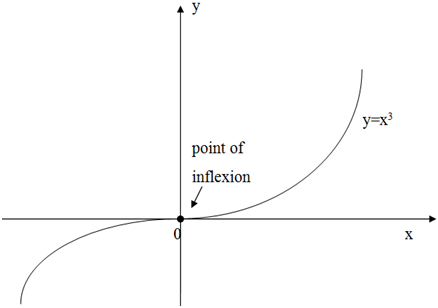
                                 924_Example of inflection point.png


maximize and the revenue

1. The per week revenue Sh. R of a small company is specified by

 R = (14 + 81x - (x3/12)) whereas x is the number of units produced.

Required

i.          Find out the number of units that maximize the revenue

ii.         Find out the maximum revenue

iii.        Find out the price per unit that will maximize revenue

Solution

i. To determine maximum or minimum value we needs differential calculus as given below:

R = (14 + 81x - (x3/12))

(dR)/(dx) = 81 - (1/12) . (3x2)

(d2R)/(dx2) = 0 - (1/12) . (3.2x) = -(x/2)

Put (dR)/(dx) = 0 that is 81 - (1/4)x2 = 0

That gives x = 18 or x = -18

(d2R)/(dx2) = -(x/2)

Hence when x = 18;

(d2R)/(dx2) = -9

That is (-) negative indicating a maximum value.

Hence at x = 18, the value of R is a maximum. Correspondingly at x = -18, the value of R is a minimum. Thus, the number of units that maximize the revenue = 18 units

i. The maximum revenue is given as

            R = 14 + 81 + 18 - ((18)3)/12

                        = Shs. 986

ii.The price per unit to maximize the revenue is given as:

986/18 = 54.78 or Shs.54.78


Related Discussions:- Example of inflection point-differential equation

value of integration , what is the value of integration limit n-> infinity...

what is the value of integration limit n-> infinity [n!/n to the power n]to the power 1/n Solution)  limit n-->inf.    [1 + (n!-n^n)/n^n]^1/n = e^ limit n-->inf.    {(n!-n^n)

Linear equations, Linear Equations - Resolving and identifying linear fir...

Linear Equations - Resolving and identifying linear first order differential equations. Separable Equations - Resolving and identifying separable first order differential

Shares and dividends, to use newspaperto study and report on shares and div...

to use newspaperto study and report on shares and dividend

Example of repeated eigenvalues, Illustration : Solve the following IVP. ...

Illustration : Solve the following IVP. Solution: First get the eigenvalues for the system. = l 2 - 10 l+ 25 = (l- 5) 2 l 1,2 = 5 Therefore, we got a

Prove that three times the sum of the squares, Prove that three times the s...

Prove that three times the sum of the squares of the sides of a triangle is equal to four times the sum of the squares of the medians of the triangle. Ans:    To prove 3(AB 2

Create a circular table with no restrictions, 1. Four different written dri...

1. Four different written driving tests are administered by a city. One of these tests is selected at random for each applicant for a drivers license. If a group of 2 women and 4 m

Product rule, Product Rule If the two functions f(x) & g(x) are differe...

Product Rule If the two functions f(x) & g(x) are differentiable (i.e. the derivative exist) then the product is differentiable and,

Write Your Message!

Captcha
Free Assignment Quote

Assured A++ Grade

Get guaranteed satisfaction & time on delivery in every assignment order you paid with us! We ensure premium quality solution document along with free turntin report!

All rights reserved! Copyrights ©2019-2020 ExpertsMind IT Educational Pvt Ltd