Example of back face detection method, Data Structure & Algorithms

Assignment Help:

Example of Back Face Detection Method

To illustrate the method, we shall start with the tetrahedron (pyramid) PQRS of     Figure with vertices P (1, 1, 2), Q (3, 2, 3), R (1, 4, 1), and S (2, 4,0). It is obviously a convex object, re-entrant angles just not being possible with triangles. In this case we may be able to guess that the vertex S is behind the triangle PQR, and also that faces PQR and QRS are visible, and the other two faces PQS and PRS are hidden. But the computer must be able to decide for itself and we too cannot decide for more than one tetrahedron. So, let us start with the order PQR as counter-clockwise with the triangle facing the viewer, as shown by the arrows along the edges in Figure. Then, for the adjacent triangle QRS, at its common edge QR with the triangle PQR, the arrow must point in the opposite direction, namely from R to S as shown, and hence the vertices must indeed be ordered as RQS (or QSR, or SRQ), as in Figure 3.3(b).

The vertex sequences of the other two triangles are also followed by the same logic : For the  trianglePRS, from the common edge PR with triangle PQR, the vertex sequence must be PRS (or RSP, or SPR), as in Figure. We could have also used the common edge RS with triangle QRS to get the same result. For triangle PQS, from anyone of the three common edges with the other three triangular faces, the vertex sequence will be determined as PSQ (or SQP, or QPS), as in Figure.
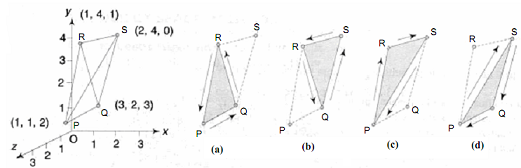
 

1859_data structure.png


Related Discussions:- Example of back face detection method

Deletion of any element from the queue, Program segment for the deletion of...

Program segment for the deletion of any element from the queue delmq(i)  /* Delete any element from queue i */ { int i,x; if ( front[i] == rear[i]) printf("Queue is

Construction of a binary tree , Q. Construct a binary tree whose nodes in i...

Q. Construct a binary tree whose nodes in inorder and preorder are written as follows: Inorder : 10, 15, 17, 18, 20, 25, 30, 35, 38, 40, 50 Preorder: 20, 15, 10

Adjacency list representation, Adjacency list representation An Adjacen...

Adjacency list representation An Adjacency list representation of Graph G = {V, E} contains an array of adjacency lists mentioned by adj of V list. For each of the vertex u?V,

Doubly linked list, How does operations like insertion, deletion occur?

How does operations like insertion, deletion occur?

Name the four data type groups, There are four data type groups:  I...

There are four data type groups:  Integer kepts whole numbers and signed numbers Floating-point Stores real numbers (fractional values). Perfect for storing bank deposit

Algorithm to sort a given list by quick sort method, Q. Write down an algor...

Q. Write down an algorithm to sort a given list by making use of Quick sort method. Describe the behaviour of Quick sort when input given to us is already sorted.

Insertion of a node into an avl tree, Initially Nodes are inserted in an AV...

Initially Nodes are inserted in an AVL tree in the same manner as an ordinary binary search tree. Though, the insertion algorithm for any AVL tree travels back along with the pa

Polynomials - represented by using arrays, /* the program accepts two polyn...

/* the program accepts two polynomials as a input & prints the resultant polynomial because of the addition of input polynomials*/ #include void main() { int poly1[6][

Searching techniques, Searching is the procedure of looking for something. ...

Searching is the procedure of looking for something. Searching a list containing 100000 elements is not the similar as searching a list containing 10 elements. We discussed two sea

Write Your Message!

Captcha
Free Assignment Quote

Assured A++ Grade

Get guaranteed satisfaction & time on delivery in every assignment order you paid with us! We ensure premium quality solution document along with free turntin report!

All rights reserved! Copyrights ©2019-2020 ExpertsMind IT Educational Pvt Ltd