Evalute right-hand limit, Mathematics

Assignment Help:

Evaluate following limits.

2454_limit90.png

Solution

Let's begin with the right-hand limit.  For this limit we have,

x > 4  ⇒          4 - x < 0          ⇒ ( 4 - x )3  = 0      also, 4 - x → 0  as x → 4 .  Therefore, we contain a positive constant divided by an increasingly small -ve number. The results will be an increasingly large -ve number and hence it looks like the right-hand limit will be negative infinity.

For the left-handed limit we have following,

x < 4 ⇒           4 - x > 0          ⇒ ( 4 - x )3  > 0 and still we have, 4 - x → 0  as x → 4 .  In this case we contain a positive constant divided by an increasingly small +ve number.  The results will be an increasingly large positive number and hence it looks like the left-hand limit will be positive infinity.

The normal limit will not present since the two one-sided limits are not the similar.  The official answers to this example are then,

2071_limit91.png

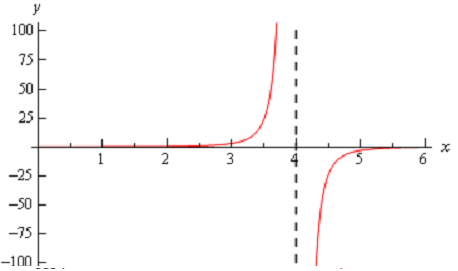
Following is a quick sketch to verify our limits.
714_limit92.png

Facts

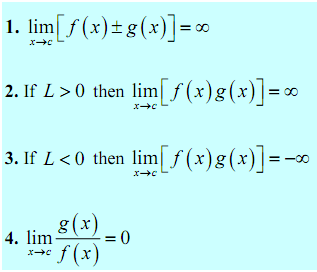
Given the functions f ( x )& g ( x ) assume we have,

1466_limit93.png

for some real numbers c & L. Then,

1540_limit94.png


Related Discussions:- Evalute right-hand limit

Uniform distribution over the interval, High temperatures in certain city i...

High temperatures in certain city in the month of August follow uniform distribution over the interval 60-85 F. What is probability that a randomly selected August day has a Temper

Number of permutations of ''n'' dissimilar things , Finding the numbe...

Finding the number of Permutations of 'n' dissimilar things taken 'r' at a time:  After looking at the definition of permutations, we look at how to evolve a

., Two boys A and B are at two diametrically opposite points on a circle. A...

Two boys A and B are at two diametrically opposite points on a circle. At one instant the two start running on the circle; A anticlockwise with constant speed v and B clockwise wit

Polynomials in one variable, Polynomials In this section we will discu...

Polynomials In this section we will discuss about polynomials.  We will begin with polynomials in one variable. Polynomials in one variable Polynomials in one variable

Show that 571 is a prime number, Show that 571 is a prime number. Ans: ...

Show that 571 is a prime number. Ans:    Let x=571⇒√x=√571 Now 571 lies between the perfect squares of  (23)2 and (24)2 Prime numbers less than 24 are 2,3,5,7,11,13,17,1

Numbers, use the distributive law to write each multiplication in a differe...

use the distributive law to write each multiplication in a different way. the find the answer. 12x14 16x13 14x18 9x10⁸ 12x136 20x147

Write algorithm for the multiplication of a 3-digit number, E1) Why do we s...

E1) Why do we shift the place by one, of the result in the second row of the calculation, when we multiply, say, 35 by 237 E2) Write down the algorithm for the multiplication of

Write Your Message!

Captcha
Free Assignment Quote

Assured A++ Grade

Get guaranteed satisfaction & time on delivery in every assignment order you paid with us! We ensure premium quality solution document along with free turntin report!

All rights reserved! Copyrights ©2019-2020 ExpertsMind IT Educational Pvt Ltd