Evaluate limit, Mathematics

Assignment Help:

Evaluate the given limit.
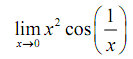
1478_limit55.png

Solution: In this question none of the earlier examples can help us. There's no factoring or simplifying to accomplish.  We can't rationalize & one-sided limits won't work. There's still a question as to whether this limit will present as we have division by zero within the cosine at x=0.

The firstly thing to notice is that we know the given fact about cosine.

                                                -1 ≤ cos ( x )≤ 1

Our function doesn't contain just an x in the cosine, however as long as we ignore x =0 we can say the similar thing for our cosine.

                                                       -1 ≤ cos ( 1/x ) ≤ 1

It's okay for us to avoid x = 0 here since we are taking a limit and we know which limits don't care regarding what's in fact going on at the point in question, x = 0 in this case.

Now if we have the above inequality for our cosine we can only multiply everything by an x2 and get the following.

                                             - x2  ≤ x2 cos ( 1/x ) ≤ x2

In other terms we've managed to squeeze the function which we were interested in among two other functions which are very easy to deal with.  Hence, the limits of the two outer functions are.

2134_limit56.png

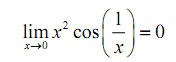
These are the similar and hence by the Squeeze theorem we has to also have,
1859_limit57.png

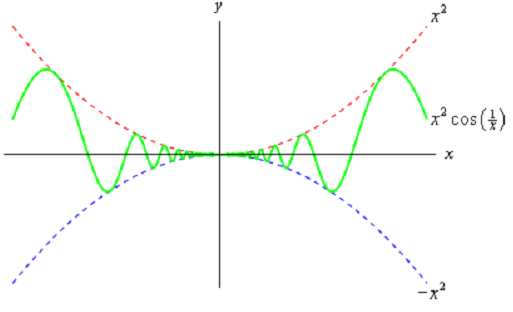
We can check this with the graph of the three functions.  This is illustrated below.
2107_limit58.png


Related Discussions:- Evaluate limit

Trigonometry, Prove: cotA/2.cotB/2.cotC/2 = cotA/2+cotB/2+cotC/2

Prove: cotA/2.cotB/2.cotC/2 = cotA/2+cotB/2+cotC/2

Hypergeometric distribution, Hypergeometric Distribution Consider the p...

Hypergeometric Distribution Consider the previous example of the batch of light bulbs. Suppose the Bernoulli experiment is repeated without replacement. That is, once a bulb is

Chain rule, Chain Rule :   If f(x) and g(x) are both differentiable func...

Chain Rule :   If f(x) and g(x) are both differentiable functions and we describe F(x) = (f. g)(x) so the derivative of F(x) is F′(x) = f ′(g(x)) g′(x).  Proof We will s

Time table, tips to memorize my time table

tips to memorize my time table

Highest common factor (hcf), We know that a factor is a quantity whic...

We know that a factor is a quantity which divides the given quantity without leaving any remainder. Similar to LCM above we can find a highest common factor (HCF)

Find the common difference & write the next 3 terms, If the following terms...

If the following terms form a AP. Find the common difference & write the next 3 terms3, 3+ √2, 3+2√2, 3+3√2.......... Ans:    d= √2 next three terms 3 + 4 √ 2 , 3 + 5√ 2 ,

Permuation and combination, how many words can be formed from letters of wo...

how many words can be formed from letters of word daughter such that each word contain 2vowles and 3consonant

Interval of convergence - sequences and series, Interval of Convergence ...

Interval of Convergence After that secondly, the interval of all x's, involving the endpoints if need be, for which the power series converges is termed as the interval of conv

Find out arc length - applications of integrals, Find out the length of y =...

Find out the length of y = ln(sec x ) between 0 x π/4. Solution In this example we'll need to use the first ds as the function is in the form y = f (x). So, let us g

Write Your Message!

Captcha
Free Assignment Quote

Assured A++ Grade

Get guaranteed satisfaction & time on delivery in every assignment order you paid with us! We ensure premium quality solution document along with free turntin report!

All rights reserved! Copyrights ©2019-2020 ExpertsMind IT Educational Pvt Ltd