Draw the direction field, Mathematics

Assignment Help:

Draw the direction field for the subsequent differential equation. Draw the set of integral curves for this differential equation.

 Solution:

 y′ = y - x

 To draw direction fields for this type of differential equation we initially know places where the derivative will be constant. To complete this we set the derivative into the differential equation equivalent to a constant, as c. It provides us a family of equations, termed as isoclines, which we can plot and on each of these curves the derivative will be a constant value of c.

Remember here that in the previous illustrations we looked at the isoclines for c = 0 to find the direction field started. In our case the family of isoclines is as:

c = y - x

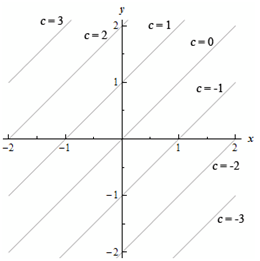
These curve's graph for several values of c is demonstrated below.
206_Draw the direction field.png

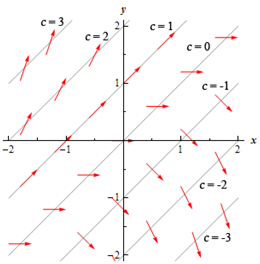
Here, on each of these lines, or isoclines, the derivative will be not change and will have a value of c. At c = 0 isoclines the derivative will all the time have a value of zero and thus the tangents will all be horizontal. At c = 1 isoclines the tangents will all the time have a slope of 1 and at c = -2 isoclines the tangents will all the time have a slope of -2 and so on. Below is some tangents place in for each of these isoclines.
2236_Draw the direction field1.png

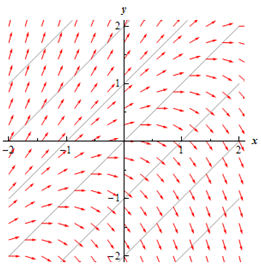
To add extra arrows for those areas among the isoclines start at say, c = 0 and move up to c = 1 and when we do this we raise the slope of the arrows or tangents from 0 to 1. It is demonstrated in the figure below.
892_Draw the direction field2.png

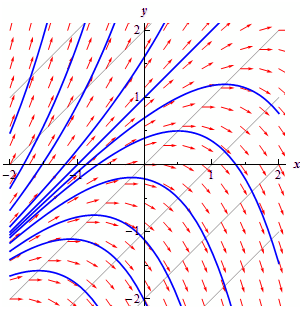
We can after that adds in integral curves as we did in the previous illustrations. It is demonstrated in the figure below.
2408_Draw the direction field3.png


Related Discussions:- Draw the direction field

Listing method, how will you explain the listing method?

how will you explain the listing method?

Circles and cones, length of subnormal to the curve y2=2x+1 at (4,3)

length of subnormal to the curve y2=2x+1 at (4,3)

Describe adding and subtracting fractions in details, Describe Adding and S...

Describe Adding and Subtracting Fractions in details? To add or subtract fractions, here are some steps: 1. Find the lowest common denominator (LCD) or any common denominato

Calculate values of the derivative, First, see that the right hand side of ...

First, see that the right hand side of equation (2) is a polynomial and thus continuous. This implies that this can only change sign if this firstly goes by zero. Therefore, if the

What do you mean by transient state, What do you mean by transient state an...

What do you mean by transient state and steady-state queueing systems If the characteristics of a queuing system are independent of time or equivalently if the behaviour of the

Fractions, What fraction could you add to 4/7 to get a sum greater than 1

What fraction could you add to 4/7 to get a sum greater than 1

Define period, Q. Define Period, Amplitude and Phase Shift? Ans. P...

Q. Define Period, Amplitude and Phase Shift? Ans. Period, amplitude and phase shift are used when describing a sinusoidal curve The period of a function is the smallest

Concurrent deviation method, Normal 0 false false false ...

Normal 0 false false false EN-IN X-NONE X-NONE

Write Your Message!

Captcha
Free Assignment Quote

Assured A++ Grade

Get guaranteed satisfaction & time on delivery in every assignment order you paid with us! We ensure premium quality solution document along with free turntin report!

All rights reserved! Copyrights ©2019-2020 ExpertsMind IT Educational Pvt Ltd