Describe about parallel and perpendicular lines, Mathematics

Assignment Help:

Describe about Parallel and Perpendicular Lines ?

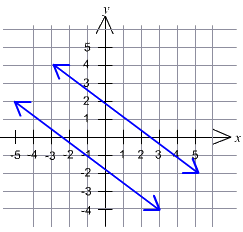
Parallel Lines : Parallel lines are coplanar lines (lines that lie in the same plane) that never intersect.
2217_Parallel and Perpendicular Lines.png


The blue lines are parallel. Notice that these lines have the same slope.
Two lines with the same slope are parallel.
If they had different slope then they would intersect and so they wouldn't be parallel.
If two no vertical lines are parallel, they have the same slope.
What if the lines are vertical?
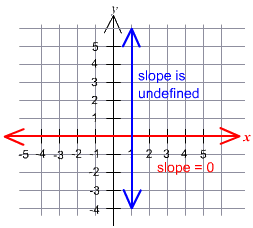
If two vertical lines are parallel, they both have undefined slope.
(See example 2 for more on horizontal and vertical lines.)
Perpendicular Lines
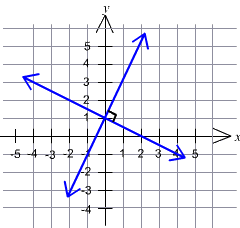
Perpendicular lines intersect at an angle of 90 degrees, in other words they form a right angle.
28_Parallel and Perpendicular Lines 1.png


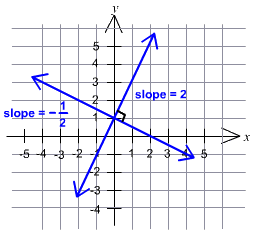
How do the slopes of these perpendicular lines compare to each other?
1301_Parallel and Perpendicular Lines 2.png


The slopes of the two perpendicular lines are 2 and -1/2. How are these slopes related? -1/2 is the negative reciprocal of 2. (See the basics section for more about negative reciprocals.)
If two lines are perpendicular, their slopes are negative reciprocals.
1752_Parallel and Perpendicular Lines 3.png

If the slopes of two lines are negative reciprocals, then the lines are perpendicular.

Example 1: What is the slope of a line that is
a. parallel to 12x - 3y = 10?
b. perpendicular to 12x - 3y = 10?
Solution: First let's find the slope of the line 12x - 3y = 10.
Put the equation in the form y = mx + b.
12x - 3y = 10
-3y = -12x +10
-3y/-3 = -12x/-3 +10/-3
Y= -4x -10/3
The slope of the line is -4.
a. All lines that are parallel to 12x - 3y = 10 have slope equal to this line. The slope of a line parallel to 12x - 3y = 10 is -4.
b. All lines that are perpendicular to 12x - 3y = 10 have slope equal to the negative reciprocal of -4. The negative reciprocal of -4 is 1/4, so the slope of a line perpendicular to 12x - 3y = 10 is 1/4.

Example 2: What is the slope of a line that is
a. parallel to the x'axis?
b. perpendicular to the x'axis?
Solution: The x'axis is a horizontal line. All horizontal lines have zero slope.
a. A line parallel to the x'axis has slope = 0.
b. A line perpendicular to the x'axis is vertical. All vertical lines have undefined slope.


Related Discussions:- Describe about parallel and perpendicular lines

Use newtons method to find out an approximation, Use Newton's Method to fin...

Use Newton's Method to find out an approximation to the solution to cos x = x which lies in the interval [0,2].  Determine the approximation to six decimal places. Solution

Arc Length and Sector Area, how do i find the diameter of a circle if i hav...

how do i find the diameter of a circle if i have the shaded sectors area of 263.76 and the central angle of that circle is 210 degrees?

MATH, I don''t understand so what is 3 (8-x);24-15

I don''t understand so what is 3 (8-x);24-15

MUTIPLYING FRACTIONS, EVERY TIME I TRY TO DO ANY KIND OF FRACTIONS WELL MUL...

EVERY TIME I TRY TO DO ANY KIND OF FRACTIONS WELL MULTIPLYING I ALWAYS GET IT WRONG

Why is vector division undefined, Division basically refers to multiplicati...

Division basically refers to multiplication of reciprocal. For example a/b is same as a*1/b or we can say, is same as a*b -1 , which is "a" multiplied to the inverse of "b". There

Polynomial : f(x).f(1/x), A polynomial satisfies the following relation f(x...

A polynomial satisfies the following relation f(x).f(1/x)= f(x)+f(1/x). f(2) = 33. fIND f(3) Ans) The required polynomial is x^5 +1. This polynomial satisfies the condition state

Probability, An unbiased die is tossed twice .Find the probability of getti...

An unbiased die is tossed twice .Find the probability of getting a 4,5,6 on the first toss and a 1,2,3,4 on the second toss

Differential equation, Cos(x+y)+sin(x+y)=dy/dx(solve this differential equa...

Cos(x+y)+sin(x+y)=dy/dx(solve this differential equation)

Solve 8 cos2 (1 - x ) + 13 cos(1 - x )- 5 = 0 trig function, Solve 8 cos 2 ...

Solve 8 cos 2 (1 - x ) + 13 cos(1 - x )- 5 = 0 . Solution Now, as specified prior to starting the instance this quadratic does not factor.  Though, that doesn't mean all i

Write Your Message!

Captcha
Free Assignment Quote

Assured A++ Grade

Get guaranteed satisfaction & time on delivery in every assignment order you paid with us! We ensure premium quality solution document along with free turntin report!

All rights reserved! Copyrights ©2019-2020 ExpertsMind IT Educational Pvt Ltd