Demand for risky assets, Microeconomics

Assignment Help:

Demand for Risky Assets

*  Assets

- Something which provides a flow of money or services to its owner.

-  The flow of money or services can be explicit or implicit .

*  Capital Gain 

- An increase in value of an asset, while the decrease is a capital loss.

*  Risky & Riskless Assets

- Risky Asset 

  • Provides uncertain flow of money or services to the owner.
  • Examples

- Apartment rent, corporate bonds, capital gains, stock prices

- Riskless Asset

  • Provides flow of money or services which is known with certainty.
  • Examples

- Short term government bonds, short term certificates of deposit

*  Asset Returns

- Return on an Asset

-  The total monetary flow of asset as fraction of its price.

- Real Return of an Asset

-  The simple return less the rate of inflation.

*  Asset Returns

  Expected versus Actual Returns

- Expected Return

  • Return which an asset should earn on average

- Actual Return

  • Return which an asset earns

- Higher returns are associated with the greater risk.

- The risk averse investor should balance risk relative to return

* Risk and Budget Line

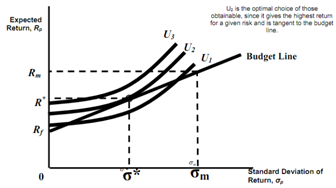
  Expected return, RP, increases as the risk increases.

 The slope is price of risk or risk-return trade-off.

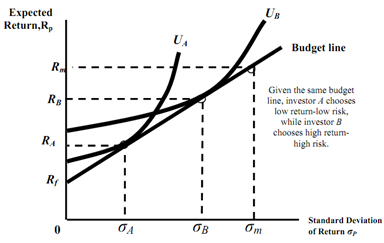
Choosing Between Risk and Return
493_choices of two different investors.png

The Choices of Two Different Investors
151_choices of two different investors1.png


Related Discussions:- Demand for risky assets

Long run eq, The raspberry growing industry is a perfectly competitive indu...

The raspberry growing industry is a perfectly competitive industry. The firms in the industry have a U-shaped LAC, minimum average cost is $8 and the minimum efficient scale is 4 u

Motives of regional financial institutions, Motives of regional financial i...

Motives of regional financial institutions: There are mixed motives for the donor countries to provide development assistance to developing nations. While a desire for poverty

Source of economic growth and development, Question: (a) Explain the fa...

Question: (a) Explain the factors that contributed to the adoption of structural adjustment programme by a majority of Least Developed Countries in the 1980s? (b) Describe t

Ccc, #question.ccccc

#question.ccccc

Preference to non-debt creating capital flows, Preference to Non-debt Creat...

Preference to Non-debt Creating Capital Flows: The most important element of strategy has been the paradigm shift in the attitude towards inflow of capital from abroad. Capit

Explain why both the pes and ped tend to be inelastic, Explain why both the...

Explain why both the PES and PED tend to be inelastic in the short run for primary goods. PED deals with (primarily) the ability and propensity of consumers to switch to other

#titlefree trade and protectionsm .., why is international trade important ...

why is international trade important for south africa

Growth and patterns multipliers theory, (a) Reasons of Urban Growth (b) Cha...

(a) Reasons of Urban Growth (b) Characteristics of Urban Growth (c) Economic Life of a Building (d) Zone of Transition (e) Location Theory (f) Patterns of Growth Theory (g) Growth

Population information, What population information is needed by local auth...

What population information is needed by local authorities to provide the right number of primary and secondary school places? How would such information affect the plans of the lo

Write Your Message!

Captcha
Free Assignment Quote

Assured A++ Grade

Get guaranteed satisfaction & time on delivery in every assignment order you paid with us! We ensure premium quality solution document along with free turntin report!

All rights reserved! Copyrights ©2019-2020 ExpertsMind IT Educational Pvt Ltd