Data processing, Basic Computer Science

Assignment Help:

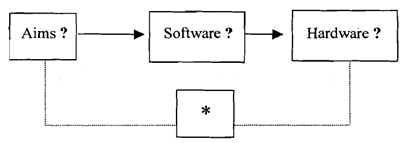
Data Processing : Processing data is the most complex function of a computer system. It is where the computer itself (as opposed to a peripheral, e.g. a visual display unit or a printer) is brought into play together with suitable programs. We will discuss programs, or software, later; so here let us consider what kind of management decisions need to be taken in relation to the hardware - the computer itself. In practice, when you choose a computer system, you decide:

(I) What your aims are;

(2) What programs (software) will meet those aims; and

(3) What machines (hardware) will support the programs.
1867_data output.png

Figure: Choosing a Computer System.

Sometimes your aims affect the choice of hardware directly. For example, you require more than one person to gain access to the system at a time; you will need a multi-user system.

In defining your aims, you will define what data processing needs to take place and this will lead to a number of options - choices of programs. Once you have chosen a program for your task you will usually have a range of options, and a,set of parameters for choosing hardware you may ask:

Will you require a stand-alone workstation, a network, or a full multi-user system?

What size RAM (the computers own working memory) is required to support the program?

What size hard disk (data store) is required?

What data storage method will you use for backing up information?

What is the cost of the computer and its subsequent maintenance?


Related Discussions:- Data processing

Kirchhoff’s law, A car battery is of 12 V. Eight dry cells of 1.5 V each ...

A car battery is of 12 V. Eight dry cells of 1.5 V each connected in series can give 12 V. But such cells are not used in starting a car. Why?

Explain Debug program in assembly language , To make a program in assemble...

To make a program in assembler two choices exist, the earliest one is to use the TASM or Turbo Assembler, of Borland, and the next one is to use the debugger, generally we use this

Fourth generation of computers, THE FOURTH GENERATION (1975 ONWARDS) ...

THE FOURTH GENERATION (1975 ONWARDS) This generation of computers have one or more of the following characteristics:     Semi-conductor memory instead of core memo

Third generation of computers, THE THIRD GENERATION (1966-1975) ...

THE THIRD GENERATION (1966-1975) The introduction of IBM-360 series of computers in 1965 marked the beginning of this generation. The transistors were replaced by solid

Excel, how to use excel..

how to use excel..

Logic and arithmetic functions, The instructions of the logic functions are...

The instructions of the logic functions are: and not, or and xor. These act on the bits of their operators. To make sure the result of the operations we revolve to the cmp and test

Hill climbing - artificial intelligence , Hill Climbing - artificial intell...

Hill Climbing - artificial intelligence: As we've seen, in some particular problems, searching the search path from primly to goal state is the point of the exercise. In anothe

Describe the binary search algorithm, QUESTION 1 Describe the binary se...

QUESTION 1 Describe the binary search algorithm using an example of your own. QUESTION 2 (a) By showing all your workings, give a big-O estimate for f(x) = (x + 1)lo

Describe what are system software and application software, Problem: (a...

Problem: (a) Using appropriate examples describe what are System software and Application Software. (b) Explain four tasks of file management a user frequently performs i

Write Your Message!

Captcha
Free Assignment Quote

Assured A++ Grade

Get guaranteed satisfaction & time on delivery in every assignment order you paid with us! We ensure premium quality solution document along with free turntin report!

All rights reserved! Copyrights ©2019-2020 ExpertsMind IT Educational Pvt Ltd