Calculate force required for equilibrium, Mechanical Engineering

Assignment Help:

Calculate force required for equilibrium:

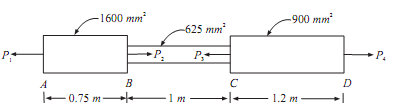
A member ABCD is subjected to the point loads P1, P2, P3  and P4  as shown in the figure given below
700_Calculate force required for equilibrium.png

Calculate force P3 required for equilibrium if P1 = 120 kN, P2 = 220 kN and P4 = 160 kN. Determine the net change in length of member. Take E = 200 GN/m2.
Sol.: Modulus of elasticity E = 200 GN/ m2 = 2 × 10⁵ N/mm2.

By considering equilibrium of forces along axis of the member.

P1 + P3 = P2 + P4;

120 + P3 = 220 + 160

Force P3 = 220 + 160 - 120 = 260 kN

The forces which are acting on each segment of member are shown in free body diagrams shown below:

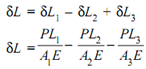
Let  δL1,  δL2 and  δL3,  be extensions in parts 1, 2 and 3 of steel bar respectively. Then,

 

845_Calculate force required for equilibrium1.png 
As, Tension in AB and CD but compression in BC,
So, Total extension of the bar,
   1318_Calculate force required for equilibrium2.png 
Extension of segment AB = [(120 × 103) × (0.75 × 103)]/[1600 × (2 × 105)] = 0.28125 mm

Compression of segment BC = [(100 ×103) × (1 × 103)]/[625 × (2 × 105)] = 0.8 mm

Extension of segment CD = [(160 ×103) × (1.2 × 103)]/[900 × (2 × 105)] = 1.0667 mm

Net change in length of the member = δl =0.28125 - 0.8 + 1.0667 = 0.54795 mm (increase)        .......ANS


Related Discussions:- Calculate force required for equilibrium

Explain newtons law of cooling, Explain Newton's Law of cooling. What do yo...

Explain Newton's Law of cooling. What do you mean by convective Heat Transfer coefficient ? What are the factors on which co-efficient of convective heat transfer (h) depends upon

Evaluation the enthalpy of steam - thermodynamics, Evaluatio n the Enthalp...

Evaluatio n the Enthalpy of Steam: Let h f   = Heat of liquid or sensible heat of water in KJ/kg h f g   = Latent heat of vaporization of steam in KJ/kg t

Estimate the viscosity of this diluted , A diluted polymer solution with a ...

A diluted polymer solution with a density of 1130 kg/m3 was extruded through a capillary tube of 3.5 mm internal diameter and 1 m long. The following results were obtained at 25°C.

Magnitude, Magnitude, direction and position of resultant force: Q : ...

Magnitude, direction and position of resultant force: Q : A horizontal line PQRS is 12 m long, and PQ = QR = RS = 4m. Forces of 1000, 1500, 1000 and 500 N act at P ,

Find the machine fraction for machine operation, 1.Two machining operations...

1.Two machining operations, A (3 minutes per part) and B (10 minutes per part), are performed sequentially to manufacture a part. Machines A and B produce 5% and 6% defective items

Main factors to be considered when selecting material, Main Factors to be C...

Main Factors to be Considered when Selecting Material The main factors to be considered when selecting a material to meet some specific requirement are: Fitness of use,

Describe inversion and mechanism, Describe Inversion and Mechanism. Illustr...

Describe Inversion and Mechanism. Illustrate in detail all inversions of 4-Bar chain Mechanism. (a) Explain all the types of constrained motion with examples. (b) Explain in

Determine the root of equation, Calculate the value of ∫ Π/2 sinx dx by Si...

Calculate the value of ∫ Π/2 sinx dx by Simpson's 1/3 rule using 11 ordinates. Determine the root of equation xe x = cosx using secant method correct to four decimal places.

Evaluting Properties, A piston-cylinder assembly fitted with a paddle wheel...

A piston-cylinder assembly fitted with a paddle wheel contains air, initially at p1=30 lbf/in2, T1=540 °F, and V1=4 ft3. The air undergoes a process to a final state where p2=20 lb

Write Your Message!

Captcha
Free Assignment Quote

Assured A++ Grade

Get guaranteed satisfaction & time on delivery in every assignment order you paid with us! We ensure premium quality solution document along with free turntin report!

All rights reserved! Copyrights ©2019-2020 ExpertsMind IT Educational Pvt Ltd