Cache simulater, Computer Engineering

Assignment Help:

Requirements

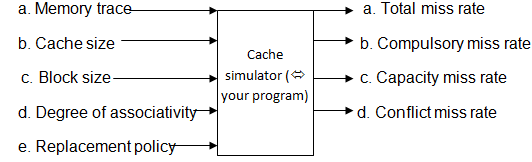
You are required to program (in a high level language such as C, C++, Java) and implement a cache simulator which will have the following inputs and outputs:-
 

2119_Cache Simulater.png

Memory trace ó smalltex.din (during code development microtex.din - see later) and each address is the current address, in RAM, of a Byte required by the CPU.

Cache size ó size of cache in bytes

Block size ó size of blocks in bytes

Degree of associativity ó direct (1-way), 2-way, 4-way, 8-way,  and fully associative

Replacement policy ó Random and LRU are to be implemented.

Total miss rate = compulsory + capacity + conflict miss rates.

* The memory trace file (smalltex.din) is located at

            /home/csiii/csiiilib/arc/smalltex.din        or

            /home/3rd/csiiilib/arc/smalltex.din

Copy this file to your arc directory where you will be running your assignment from.


Related Discussions:- Cache simulater

Detrmine pure paging, Which is not a key piece of information, stored in si...

Which is not a key piece of information, stored in single page table entry, assuming pure paging and virtual memory Ans. A reference for the disk block which stores the page is

What is a scope resolution operator, A scope resolution operator (::), can ...

A scope resolution operator (::), can be used to describe the member functions of a class outside the class.

Assembler directives, What are assembler directives? Ans: These are th...

What are assembler directives? Ans: These are the instructions that direct the program to be executed. They have no binary corresponding so they are called pseudo-opcodes. The

Are there any special rules about inlining, Are there any special rules abo...

Are there any special rules about inlining? Yes, there are some rules about inlining - a.) Any source files which used inline function should contain function's definition.

Explain the concept of top-down design for a program, Explain the concept o...

Explain the concept of top-down design for a program. Top down Design: A top-down approach is fundamentally breaking down a system to gain insight into its compositional s

Explain interface, What is an Interface? An interface is not a class. I...

What is an Interface? An interface is not a class. It is an entity that is explained by the word Interface. An interface has no implementation; it only has the signature or in

What are the types of subroutines, What are the types of Subroutines? ...

What are the types of Subroutines? Internal Subroutines: The source code of the internal subroutines will be in the similar ABAP/4 program as the calling procedure (intern

How will you fine-tune a class, How will you fine-tune a class? It is u...

How will you fine-tune a class? It is useful to fine-tune classes before writing code in order to examine development or to improve performance. The purpose of execution is to

Write Your Message!

Captcha
Free Assignment Quote

Assured A++ Grade

Get guaranteed satisfaction & time on delivery in every assignment order you paid with us! We ensure premium quality solution document along with free turntin report!

All rights reserved! Copyrights ©2019-2020 ExpertsMind IT Educational Pvt Ltd