Built in recursive function in matlab, MATLAB in Mathematics

Assignment Help:

Built in recursive function in MATLAB:

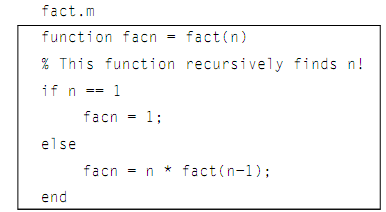
We have seen that the built-in function in MATLAB to compute factorials, termed as the factorial and we know how to implement the iterative definition by using a running product. Now we will rather than write a recursive function known as the fact. The function will receive an integer n, which for ease will suppose is a positive integer, and will compute n! just by using the recursive definition given:
 

1287_Built in recursive function in matlab.png

The function computes one value, by using an if-else statement to select between the base and general cases. When the value passed to the function is 1, the function returns 1 as1! become equal to 1. Or else, the common case applies. According to definition, the factorial of n, that is what this function is computing, is defined as n multiplied by the factorial of (n-1). Therefore, the function assigns   n * fact(n-1) to the output argument.

How does this work? Precisely the way the illustration was sketched for 3!. Let's trace what would take place if the integer 3 is passed to the function:

fact(3) tries to assign 3 * fact(2)

fact(2) tries to assign 2 * fact(1)

fact(1) assigns 1

fact(2) assigns 2

fact(3) assigns 6

Whenever the function is initially called, 3 is not equivalent to 1, therefore the statement

facn = n * fact(n-1);

is executed. This will try to assign the value of 3 * fact(2) to  facn, but this expression cannot be computed yet and hence value cannot be assigned yet as first the value of fact(2) should be found. Therefore, the assignment statement has been interrupted by a recursive call to the fact function. The call to the function fact (2) answers in a try to assign 2 * fact(1), but again this expression cannot so far be computed. Later, the call to the function fact(1) answers in a complete execution of an assignment statement as it just assigns 1. The base case has been reached once, and then the assignment statements which were interrupted can be computed, in the reverse order.


Related Discussions:- Built in recursive function in matlab

Differentiation, Differentiation: The derivative of a function y = f(x...

Differentiation: The derivative of a function y = f(x) can be written as follows or f  '(x) and is defined as the rate of change of the dependent variable y with respe

Use of logical vector, Use of logical vector: Determine how many eleme...

Use of logical vector: Determine how many elements in the vector vec were greater than 5, the sum function can be used on the resulting vector isg: >> sum(isg) ans =

Changing dimensions, Changing Dimensions: In addition to transpose ope...

Changing Dimensions: In addition to transpose operator, the MATLAB has some built-in functions which change the dimensions or configuration of matrices, involving fliplr, resh

Writing to files, Writing to Files: There are many lower level functio...

Writing to Files: There are many lower level functions which can write to files. We will focus on the fprintf function that can be used to write a file and also to append to a

Nested if-else statements, Nested IF-ELSE statements: The if-else stat...

Nested IF-ELSE statements: The if-else statement is used to select between the two statements. In order to select from more than two statements, the if-else statements can als

Strings as matrix, Strings as matrix: The matrix can be generated, tha...

Strings as matrix: The matrix can be generated, that consists of strings in each row. Therefore, essentially it is created as a column vector of strings, but the final result

Variance, The variance is generally defined in terms of the arithmetic me...

The variance is generally defined in terms of the arithmetic mean as: At times, though, the denominator is defined as n instead of n - 1. The default definition used by t

Fliplr function - changing dimensions, Fliplr function: The fliplr fun...

Fliplr function: The fliplr function "flips" the matrix from left to right (in another words the left-most column, the first column, become the last column and so on), and the

Illustration of standard deviation, Illustration of Standard Deviation ...

Illustration of Standard Deviation The less spread out the numbers are, therefore smaller the standard deviation will be, as it is a way of determining the spread of the data.

Cholesky factorisation of packed storage matrix, If I have a vector represe...

If I have a vector representing the packed storage form of a symmetric matrix, how do I perform a cholesky factorisation on that?

Write Your Message!

Captcha
Free Assignment Quote

Assured A++ Grade

Get guaranteed satisfaction & time on delivery in every assignment order you paid with us! We ensure premium quality solution document along with free turntin report!

All rights reserved! Copyrights ©2019-2020 ExpertsMind IT Educational Pvt Ltd