Average cost function, Mathematics

Assignment Help:

Average cost function : Now let's turn our attention to the average cost function. If C ( x ) is the cost function for some of the  item then the average cost function is,

                                                  C?( x ) = C ( x ) /x

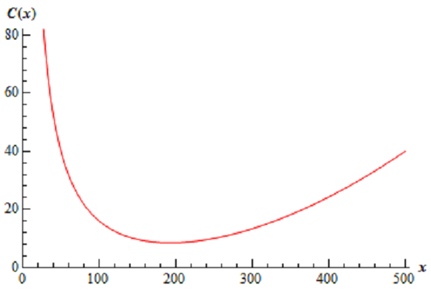
Following is the sketch of the average cost function  of this equation

 C ( x ) = 2500 -10x - 0.01x2 + 0.0002x3
1821_Average cost function.png

We can notice from this that the average cost function contain an absolute minimum.  We can also illustrate that this absolute minimum will takes place at a critical point with C′ ( x ) = 0 As it clearly will have a horizontal tangent there.

Now, we could obtain the average cost function, differentiate that and then determine the critical point. Though, this average cost function is rather typical for average cost functions therefore let's instead differentiate the general formula above by using the quotient rule & see what we have.

C?′ ( x ) = (x C′ ( x ) - C ( x )) / x2

Now, as we noted above the absolute minimum will take place when C′ ( x ) =0 and it will in turn occur while,

x C′ ( x ) - C ( x ) = 0 ⇒          C′ ( x ) =C ( x ) /x= C? ( x )

Therefore, we can see that it looks like for a typical average cost function we will obtain the minimum average cost while the marginal cost is equivalent to the average cost.

However, we have to note that not all average cost functions will look like it and therefore you shouldn't consider that this will always be the case.


Related Discussions:- Average cost function

Pat, what is a fraction?

what is a fraction?

Multiplication example, Example  Multiply 3x 5 + 4x 3 + 2x - 1 ...

Example  Multiply 3x 5 + 4x 3 + 2x - 1 and x 4 + 2x 2 + 4. The product is given by 3x 5 . (x 4 + 2x 2 + 4) + 4x 3 . (x 4 + 2x 2 + 4) + 2x .

Nonhomogeneous differential equations, Let's here start thinking regarding ...

Let's here start thinking regarding that how to solve nonhomogeneous differential equations.  A second order, linear non-homogeneous differential equation is as y′′ + p (t) y′ +

Explain peano''s axioms with suitable example, Question 1 Explain Peano's ...

Question 1 Explain Peano's Axioms with suitable example Question 2 Let A = B = C= R, and let f: A→ B, g: B→ C be defined by f(a) = a+1 and g(b) = b 2 +1. Find a) (f °g

Example of set representation, Can anybody suggest me any example of Set Re...

Can anybody suggest me any example of Set Representation?

Lines, Standard form of the line Let's begin this section off along a q...

Standard form of the line Let's begin this section off along a quick mathematical definition of a line. Any equation that can be written in the following form,

Evaluate following unit circle, Evaluate following sin 2 ?/3   and sin (-2 ...

Evaluate following sin 2 ?/3   and sin (-2 ?/3) Solution: The first evaluation in this part uses the angle 2 ?/3.  It is not on our unit circle above, though notice that  2 ?/

Derivatives of inverse trig function, Derivatives of Inverse Trig Functions...

Derivatives of Inverse Trig Functions : Now, we will look at the derivatives of the inverse trig functions. To derive the derivatives of inverse trig functions we'll required t

Write Your Message!

Captcha
Free Assignment Quote

Assured A++ Grade

Get guaranteed satisfaction & time on delivery in every assignment order you paid with us! We ensure premium quality solution document along with free turntin report!

All rights reserved! Copyrights ©2019-2020 ExpertsMind IT Educational Pvt Ltd