Assembly language assignment, Assembly Language

Assignment Help:

The main objective of the assignment is to explore the knowledge regarding parallel ports of a computer system. You can read and write datato/from the parallel port using IN and OUT instructions respectively.
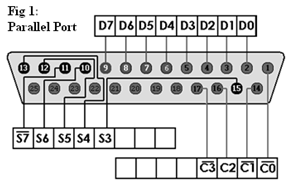
962_Assembly Language Assignment.png

Suppose we have designed a device that enables us to control the room temperature using a system's parallel port.

For this circuitry, we have to use:

1. LM35 (Temperature Sensor)

2. ADC8080 (8-bit Analog to Digital convertor)

3. Parallel Port's data and control blocks.

We have interfaced LM35 (Temperature Sensor) with ADC8080 (Analog to Digital Converter) and Parallel Port of a computer system.
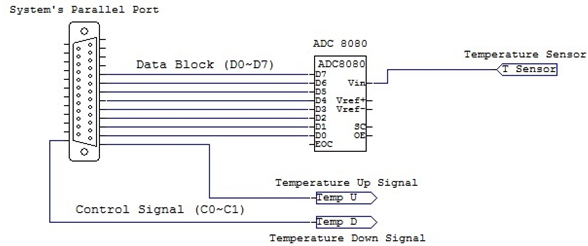
1131_Assembly Language Assignment1.png

The LM35 (temperature sensor) reads the room temperature and transmits analog data to ADC 8080 (analog to digital converter), which then converts analog reading (from sensor) to digital data (8-bit binary data). The converted digital data (b-bit binary number) will be read by processor through its parallel port and will control (either increase or decrease)the temperature of an air conditioner depending upon the working condition/criterion.

Objectives:

Students are required to code the device that controls the temperature of a room by signaling an Air Conditioner (AC).

In order to code, you have to consider the following objectives.

1. You have to read room temperature data from parallel port's data block (8-bit binary data).

2. Check either room temperature is between 21 or 23 degree Celsius (15H and 17H).

3. If Yes, No action taken (program exit).

4. If No, Check either temperature is below 21 degrees or above 23 degrees

a. If less than 21 degrees, increase the temperature by sending a pulse to Air Conditioner Control PIN C0.

b. If greater than 23 degrees, decrease the temperature by sending a pulse to Air Conditioner Control PIN C1.


Related Discussions:- Assembly language assignment

Ror-logical instruction-microprocessor, ROR : Rotate Right without Carry: ...

ROR : Rotate Right without Carry: This instruction rotates the contents of destination operand to the bit-wise right either by one or by the count specified in register CL, exclud

Explore debugger, add the contents of the defined memory locations 120, 133...

add the contents of the defined memory locations 120, 133, 122 using mov instruction in dosbox

Operating System, Why is the capability to relocate processes desirable?

Why is the capability to relocate processes desirable?

Instruction set of 8086-microprocessor, Instruction set of 8086 : The 8...

Instruction set of 8086 : The 8086/8088 instructions are categorized into the following major types. This section describes the function of each of the instructions with approp

Microcontroller, bello need help with a final project , I have to do a pres...

bello need help with a final project , I have to do a presentation on a digital stop watch , but I have to use edsim51 to make it wondering if you guys can help me

Flowchart, ALP to preform of two 16-bit numbers in register addressing mode...

ALP to preform of two 16-bit numbers in register addressing mode

Physical memory mapped and port input output-microprocessor, Physical Memor...

Physical Memory Mapped I/O and Port I/O : CPU controlled I/O comes in 2 ways. Simply the difference is whether we utilize the normal memory addresses for I/O, this is mention

Relocate program and data, ) What is the difference between re-locatable pr...

) What is the difference between re-locatable program and re-locatable data?

Nonrecursive Factorial, Write a nonrecursive version of the Factorial proce...

Write a nonrecursive version of the Factorial procedure (Section 8.3.2) that uses a loop. (A VideoNote for this exercise is posted on the Web site.) Write a short program that inte

Write Your Message!

Captcha
Free Assignment Quote

Assured A++ Grade

Get guaranteed satisfaction & time on delivery in every assignment order you paid with us! We ensure premium quality solution document along with free turntin report!

All rights reserved! Copyrights ©2019-2020 ExpertsMind IT Educational Pvt Ltd