Array vs. ordinary variable, Data Structure & Algorithms

Assignment Help:

Q. Describe what do you understand by the term array? How does an array vary from an ordinary variable? How are the arrays represented in the specific memory?                                    

Ans.

Array Vs. Ordinary Variable is explained as follows

Array is made from the similar data structure that exists in any language. Array is the set of similar or alike data types. Array is the collection of similar or alike elements. These similar or alike elements could be all int or all float or all char etc. Array of char is called as string. All elements of the given array should be of same type. An array is finite ordered set of the homogeneous elements. The number of elements in the array is pre- determined.

For example.  Ordinary variable: - int a

Array:      -      int a[10]

An ordinary variable of a simple data type can save a single element only

Representation of Array in memory is shown below

Assume a be a 2 dimensional m x n array


Col 0

Col 1

Col 2


Row 0


a00


a01


a02


Row 1


a10


a11


a12


Row 2


a20


a21


a22


Though  a  is  pictured  as  a  rectangular pattern  with  in  row  and  n  column  it  is represented in memory or a particular location by a row of m x n  elements. Sequential memory locations the element can be saved in row major order.

Column major order is explained as follows:- the elements are saved column by column i.e. m elements of the 1st column is saved in first m locations, elements of the 2nd column are saved in next m location and so on..
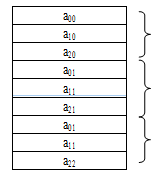
1545_column major.png

Row major order is shown below:-

The elements are saved row by row ie. N elements of the 1st row are saved in 1st n location, elements of 2nd row are saved in next n location, and so on
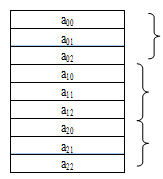
1808_row major.png


Related Discussions:- Array vs. ordinary variable

Deletion from a red-black tree, Deletion in a RBT uses two main processes, ...

Deletion in a RBT uses two main processes, namely, Procedure 1: This is utilized to delete an element in a given Red-Black Tree. It involves the method of deletion utilized in

Data structure arrays, In this unit, we learned the data structure arrays f...

In this unit, we learned the data structure arrays from the application point of view and representation point of view. Two applications that are representation of a sparse matrix

Infix expression into the postfix expression, Q. Convert the given infix ex...

Q. Convert the given infix expression into the postfix expression (also Show the steps) A ∗ (B + D)/ E - F(G + H / k ) Ans. Steps showing Infix to Post fix

Representation of a sparse matrix, Let us assume a sparse matrix from stora...

Let us assume a sparse matrix from storage view point. Assume that the entire sparse matrix is stored. Then, a significant amount of memory that stores the matrix consists of zeroe

Hashing and hash functions, Q. Describe the term hashing. Explain any two u...

Q. Describe the term hashing. Explain any two usually used hash functions. Explain one method of collision resolution.

Booth algorithm, what is boot algorithm and some example

what is boot algorithm and some example

Post order traversal, Post order traversal: The children of node are vi...

Post order traversal: The children of node are visited before the node itself; the root is visited last. Each node is visited after its descendents are visited. Algorithm fo

Collision resolution techniques, complete information about collision resol...

complete information about collision resolution techniques

A binary tree of depth "d" is an almost complete binary tree, A binary tree...

A binary tree of depth "d" is an almost complete binary tree if  A) Every leaf in the tree is either at level "d" or at level "d-1"  B)  For any node "n" in the tree with a

Write Your Message!

Captcha
Free Assignment Quote

Assured A++ Grade

Get guaranteed satisfaction & time on delivery in every assignment order you paid with us! We ensure premium quality solution document along with free turntin report!

All rights reserved! Copyrights ©2019-2020 ExpertsMind IT Educational Pvt Ltd