Area between curves, Mathematics

Assignment Help:

Area between Curves

In this section we will be finding the area between two curves. There are in fact two cases that we are going to be looking at.

In the first case we desire to find out the area between y = f ( x ) and y = g ( x ) within the interval [a,b]. We are also going to consider that f ( x ) ≥ g ( x ) .  Take a look at the given sketch to get an idea of what initially we're going to look at.
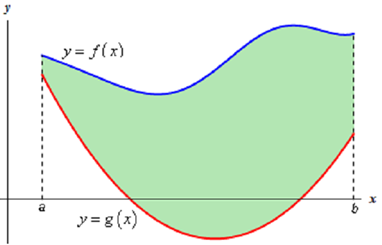
1897_arae between curve.png

Formula for area in this case

A = ∫ba f ( x ) - g ( x ) dx                                               (1)

The second case is almost similar to the first case.  Here we are going to find out the area between x = f ( y ) and x =g ( y ) on the interval [c,d] with f ( y ) ≥ g ( y ) .
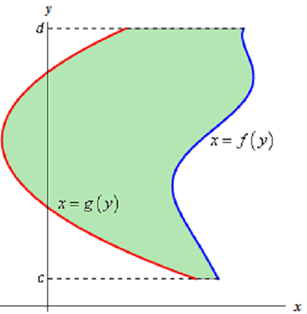
102_area between curve1.png

In this case the formula is,

 A = ∫dc f ( x ) - g ( x ) dx                                                (2)

Now (1) & (2) are entirely serviceable formulas, though, it is sometimes simple to forget that these always need the first function to be the larger of the two functions.  Therefore, rather than of these formulas we will instead utilizes the following "word" formulas to ensure that we remember that the area is always the "larger" function minus the "smaller" function.

In the first case we will utilizes,

A = ∫ba (Upper function) - (lower function) dx   a≤x≤b    (3)

In the second case we will utilize,

A = ∫dc (right function) - (left function) dx   c≤y≤d    (4)

By using these formulas will always force us to think about what is going on with each problem and to ensure that we've got the correct order of functions while we go to utilize the formula.


Related Discussions:- Area between curves

Two circles touch each other externally, Two circles touch each other exter...

Two circles touch each other externally: Given: Two circles with respective centres C1 and C2 touch each other externaly at the point P. T is any point on the common tangent

Prove the boolean expression, Prove the subsequent Boolean expression: ...

Prove the subsequent Boolean expression: (x∨y) ∧ (x∨~y) ∧ (~x∨z) = x∧z Ans: In the following expression, LHS is equal to:   (x∨y)∧(x∨ ~y)∧(~x ∨ z) = [x∧(x∨ ~y)] ∨ [y∧(x∨

Territories never was a venitian possesion, Which of those territories neve...

Which of those territories never was a Venitian possesion? Cyprus Morea Crete Sicily

Simple interest, Three payments of $2000 (originally due six months ago, to...

Three payments of $2000 (originally due six months ago, today, and six months from now) have been renegotiated to two payments: $3000 one month from now and a second payment due in

Math help, What fraction of the full price will you pay for 2 shirts? 3 4 ...

What fraction of the full price will you pay for 2 shirts? 3 4 11 2 $45.001 2 .

Prove that the height of the cloud , HE IGHTS AND DISTANCES If the ...

HE IGHTS AND DISTANCES If the angle of elevation of cloud from a point 'h' meters above a lake is α and the angle of depression of its reflection in the lake is  β , prove

Determine the height of the washington monument, Determine the height of th...

Determine the height of the Washington Monument to the nearest tenth of a meter. a. 157.8 m b. 169.3 m c. 170.1 m d. 192.2 m c. The height of the monument is the add

Example of implicit differentiation, Example of Implicit differentiation ...

Example of Implicit differentiation So, now it's time to do our first problem where implicit differentiation is required, unlike the first example where we could actually avoid

Geometry, what shapes can go into a triangular prism

what shapes can go into a triangular prism

Write Your Message!

Captcha
Free Assignment Quote

Assured A++ Grade

Get guaranteed satisfaction & time on delivery in every assignment order you paid with us! We ensure premium quality solution document along with free turntin report!

All rights reserved! Copyrights ©2019-2020 ExpertsMind IT Educational Pvt Ltd