Animation, MATLAB in Mathematics

Assignment Help:

Animation:

In this part we will observe a couple of ways to animate a plot. These are visuals, therefore the outcomes can't really be shown here; it is essential to type these into a MATLAB to view the results.

We begin by animating a plot of sin(x) with the vectors:

>> x = -2*pi : 1/100 : 2*pi;

>> y = sin(x);

This results in sufficient points that we will be able to view the result by using the built-in comet function, that shows the plot by first displaying the point (x(1),y(1)), and then moving on to the point (x(2),y(2)), and so forth, leaving a trail of all the earlier points.

   >> comet(x,y)

The final result looks similar as plot(x,y).

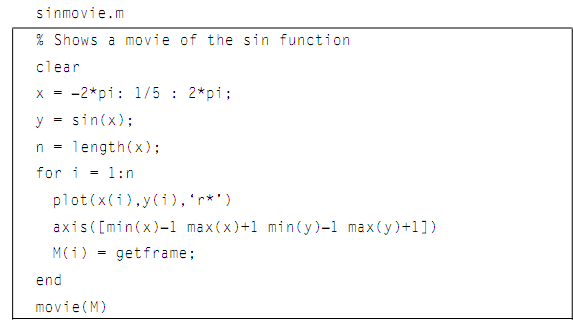
The other way of animating is to use the built-in function movie that shows recorded movie frames. The frames are captured in a loop by using the built-in function getframe, and are stored in the matrix. For illustration, the script below again animates the sin function. The axis function is used so that the MATLAB will use similar set of axes for all frames, and by using the min and max functions on the data vectors x & y will permit us to see all points.

It shows movie once in the for loop, and then again whenever the movie function is called.
2091_Animation.png


Related Discussions:- Animation

Writing and reading spreadsheet files, Writing and Reading Spreadsheet File...

Writing and Reading Spreadsheet Files: The MATLAB functions xlswrite & xlsread will write to and read from the spreadsheet files which have the extension .xls. For illustratio

Use of logical vector, Use of logical vector: Determine how many eleme...

Use of logical vector: Determine how many elements in the vector vec were greater than 5, the sum function can be used on the resulting vector isg: >> sum(isg) ans =

Structure consisting of the fields, Structure Consisting of the Fields ...

Structure Consisting of the Fields A MATLAB can also solve the sets of equations. In this illustration, the solutions for x, y, & z are returned as a structure consisting of th

Naive Gauss Reduction, Write a MATLAB function [d1, u1, l1, c1, r1] = Naive...

Write a MATLAB function [d1, u1, l1, c1, r1] = NaiveGaussArrow(d, u, l, c, r) that takes as input the 5 vectors de ned above representing A. This function performs Naive Gauss redu

Dimensions - matrix, Dimensions - matrix: The size and length function...

Dimensions - matrix: The size and length functions in the MATLAB are used to find array dimensions. Length function returns the number of elements in the vector. The size func

Example of minimum and maximum value, Example of Minimum and Maximum Value ...

Example of Minimum and Maximum Value For matrices, the functions min and max operate column wise by the default: >> mat = randint(2,4,[1 20]) mat =    9   10   1

Concatenation, Concatenation: The String concatenation means to join t...

Concatenation: The String concatenation means to join the strings altogether. Of course, as strings are merely vectors of the characters, the technique of concatenating vector

Illustration of writing to files, Illustration of Writing to files: He...

Illustration of Writing to files: Here is the other illustration in which a matrix is written to a file. At First, an arbitrary 2 × 4 matrix is generated, and then it is writt

Illustration of writing variables to a file, Illustration of Writing variab...

Illustration of Writing variables to a file: For illustration, in the below session in the Command Window, 3 variables are generated; these are then exhibited using who. Then,

Writing variables to a file, Writing variables to a File: The save com...

Writing variables to a File: The save command is used to write variables to a file, or to append the variables to a MAT-file. By the default, save function writes to a MAT-fil

Write Your Message!

Captcha
Free Assignment Quote

Assured A++ Grade

Get guaranteed satisfaction & time on delivery in every assignment order you paid with us! We ensure premium quality solution document along with free turntin report!

All rights reserved! Copyrights ©2019-2020 ExpertsMind IT Educational Pvt Ltd