Almanacs, Humanities

Assignment Help:

Almanacs

This section deals with almanacs. Like yearbooks, almanacs are also periodically published ready reference sources with similar objectives. Almanac literally means calendar of months and days containing astronomical and nautical information about the sun, moon, tides, anniversaries and so on. It is an annual calendar considering miscellaneous matters such as planetary tables, astronomical events, astrological predictions and anecdotes. But the meaning of the word `almanac' has undergone semantic change in recent days. The common meaning of almanac is an annual compendium of statistics and facts, both current and retrospective. It can widely cover a specific region or subject or it can be limited to a particular nation, country or state.

Thus, while the Shorter Oxford English Dictionary defines an almanac as "an annual table or book of tables, containing a calendar of months and days usually with astronomical data and information". Harrod's glossary calls it "a publication, generally annual, havinga variety of useful facts of a miscellaneous nature and statistical information". Librarians frequently use them as ready reference sources of statistics. At this juncture, let us compare and contrast between the yearbooks and almanacs. Though they are two distinct types of reference books, still they are similar and closely related to each other in scope and use. They are always grouped together as ready reference sources.They have fixed periodicity and are published every year. 

The major distinction between the two is in coverage in the form of duration. A yearbook is an annual compendium of descriptive and statistical data of the past year whereas the almanac inevitably covers retrospective information too. Again a yearbook is published annually but almanacs vary in periodicity e.g., Congressional Quarterly Almanac or the Almanac of American Politics (biennial), Almanac of Famous People (irregular).

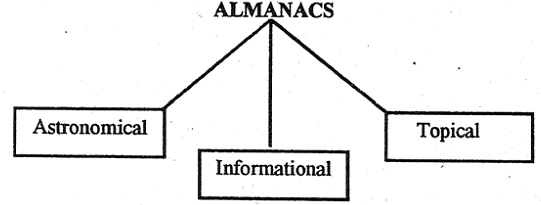
Almanacs are grouped into three distinct categories according to the scope, purpose and coverage of information.
1657_almanacs.png


Related Discussions:- Almanacs

Data elements, DATA ELEMENTS   In catalogue entries we not only provide...

DATA ELEMENTS   In catalogue entries we not only provide for access points to meet the variety of user needs to find a document but also information about the document. The inf

Human Relations in Organization, Ask qI am need answers to my work I am fai...

Ask qI am need answers to my work I am failing and need to do a lot of catching up with my work also I need it to worded correctly

Silla unification, Silla Unification Koguryo one of the 3 kingdoms i...

Silla Unification Koguryo one of the 3 kingdoms in 1~7 th century. In the North. Paekche resurgence of power in 660CE. In the West. Silla in the South. Silla look

State of the art - purpose and presentation, State of the Art - Purpose and...

State of the Art - Purpose and Presentation The State-of-the-Art Reports are of several types. They vary marginally in the presentation of the content. Though, their key purpo

Uses of ready reference sources, Uses of Ready Reference Sources We ha...

Uses of Ready Reference Sources We have surveyed various types of ready reference sources viz., yearbooks, almanacs, supplement to encyclopaedias, handbooks, manuals, guides,

Bound register/ ledger form, Bound Register/ Ledger Form   In this form...

Bound Register/ Ledger Form   In this form, the entries of documents of a library are written by hand in a bound register or ledger, pages are set apart for different letters o

Iso 2709: the international standard exchange format, ISO 2709: The Interna...

ISO 2709: The International Standard Exchange Format   ISO 2709 is an international standard format for bibliographic information interchange on megnatic tape. It was developed

Entries in a classified catalogue, Entries in a classified catalogue   ...

Entries in a classified catalogue   In Ranaganathan's Classified Catalogue we find the following entries:  1)  Main Entry       2)  Cross Reference Entries  3)  Class

White-robed, " White-robed [lay persons] will assume high seats [hitherto ...

" White-robed [lay persons] will assume high seats [hitherto reserved for monks], while monks will stand on the ground. [Their position] will be no different from that [stipulat

Write Your Message!

Captcha
Free Assignment Quote

Assured A++ Grade

Get guaranteed satisfaction & time on delivery in every assignment order you paid with us! We ensure premium quality solution document along with free turntin report!

All rights reserved! Copyrights ©2019-2020 ExpertsMind IT Educational Pvt Ltd